How much electricity does one appliance really use?
The rated power printed on an appliance does not reveal how much energy it actually consumes in one day or month. A refrigerator cycles on and off, a heater is regulated by its thermostat, and a computer changes its demand with workload.
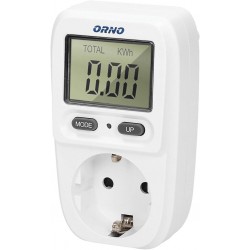
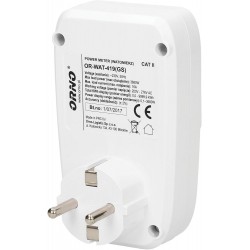
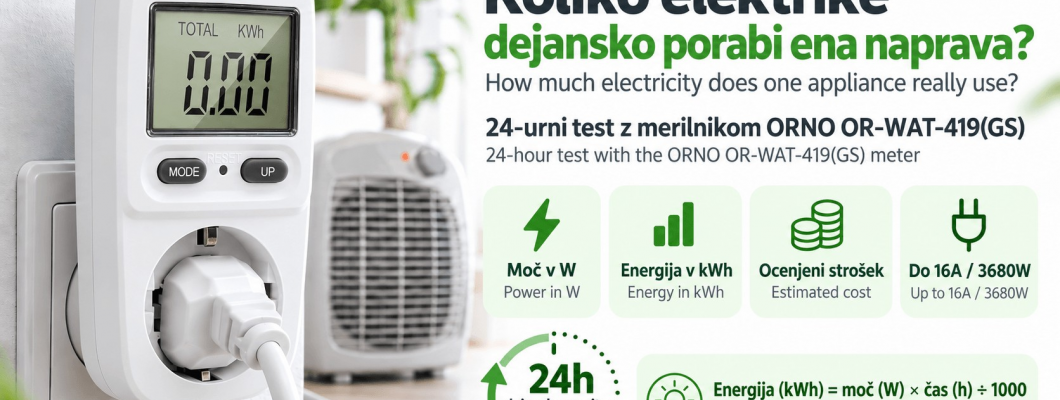
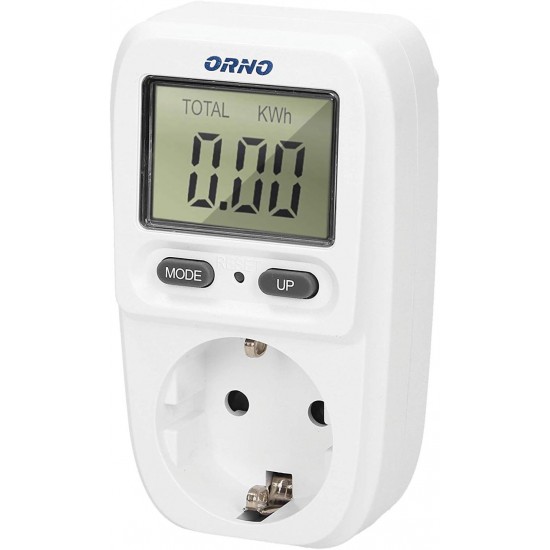
The ORNO OR-WAT-419(GS) plug-in meter displays current power, accumulated energy in kWh and an estimated cost for one connected appliance.
W, kW and kWh are not the same
W and kW: current power
Watts describe the rate at which an appliance uses energy at a particular moment. A 1500W appliance is operating at 1.5kW while drawing its full rated power.
kWh: accumulated energy
A kilowatt-hour describes energy accumulated over time. A 1kW appliance operating for two hours consumes 2kWh.
Example: a heater draws 1500W while heating. If its heating element actually operates for three hours during a day, it uses 1500 × 3 ÷ 1000 = 4.5kWh.
What does the ORNO OR-WAT-419(GS) display?
- Current power in W: what the appliance is drawing now.
- Voltage: the measured mains voltage.
- Accumulated energy in kWh: use since starting or resetting the measurement.
- Estimated cost: consumed kWh multiplied by the configured price.
- Configured €/kWh price: the value entered by the user.
A practical 24-hour measurement
- Confirm that the appliance uses a compatible 230V Type F Schuko connection.
- Confirm that it does not exceed 16A or 3680W.
- Plug the meter directly into an earthed wall socket in a dry indoor room.
- Connect the switched-off appliance to the meter and then switch it on.
- Reset old readings and note the measurement start time.
- Use the appliance normally without changing everyday habits.
- Record the accumulated kWh after 24 hours and, where useful, continue for seven days.
A one-day test works well for appliances with a reasonably repeatable daily cycle. Refrigerators, freezers, dehumidifiers and thermostatically controlled heaters should preferably be measured for a week to capture weather and usage variations.
Three concrete examples
| Measured example | Calculation | Result at €0.22/kWh |
|---|---|---|
| Standby device drawing 7W continuously | 7 × 24 × 30 ÷ 1000 | 5.04kWh or approximately €1.11 per month |
| Refrigerator measured at 0.82kWh in 24 hours | 0.82 × 30 | 24.6kWh or approximately €5.41 per month |
| 1.5kW heater with three hours of actual heating daily | 1.5 × 3 × 30 | 135kWh or approximately €29.70 per month |
The €0.22/kWh figure is only a worked example. Use a value from your own contract or bill and check which price components that value includes.
Important: the cost display is not the complete electricity bill
The ORNO meter multiplies consumed kWh by one configured price. It cannot automatically reproduce every part of a bill, multiple tariffs, time blocks, taxes or fixed charges.
Energy-based network charge
This is related to imported energy and expressed in EUR/kWh. A plug-in meter can help estimate one appliance’s contribution to accumulated energy consumption.
Power-based network charge
Agreed or excess billing power is expressed in EUR/kW and assessed at the metering-point level within time blocks—not from the accumulated kWh of one appliance.
How to interpret the result
High current power but relatively few kWh
A kettle or heater may have high power but operate only briefly. A high W reading does not automatically make it the largest monthly consumer.
Low power but surprisingly high monthly energy
A router, pump, server or standby appliance may operate continuously. A small permanent load accumulates over every hour of the month.
The displayed power changes constantly
This is normal for computers, refrigerators, thermostat-controlled heaters and regulated appliances. For these loads, accumulated kWh after a sufficiently long test is more useful.
Safety and limitations
- Use only in dry indoor areas; IP20 is not suitable for damp rooms or outdoor use.
- Never exceed 16A or 3680W.
- Do not cover the meter, and keep the wall socket accessible.
- Do not use it if its housing, contacts or plug are damaged.
- Do not open, modify or repair the unit yourself.
- The OR-WAT-419(GS) display is not backlit and requires sufficient ambient light.
Frequently asked questions
Can it measure a 1500W heater?
Yes, provided the heater has the correct Schuko connection, is undamaged and remains below 16A and 3680W. The meter must be used in a dry indoor environment.
Can it measure standby consumption?
Yes. The specified power-measurement range starts at 0.1W. For very small loads, measuring for several days makes the accumulated kWh difference easier to evaluate.
Why does its cost result differ from my bill?
The meter uses one configured price per kWh. A bill may include multiple tariffs, energy- and power-based network charges, taxes, levies and fixed charges.
Can it measure the whole apartment?
No. It is intended for one plug-in appliance. The complete property is measured by the main or advanced meter at the metering point.
Replace estimates with a real measurement
Connect the ORNO OR-WAT-419(GS) between the wall socket and an appliance to see how many watts it draws while operating and how many kWh accumulate over a day or week.
View ORNO OR-WAT-419(GS) Example load: DREO 1500W heater