
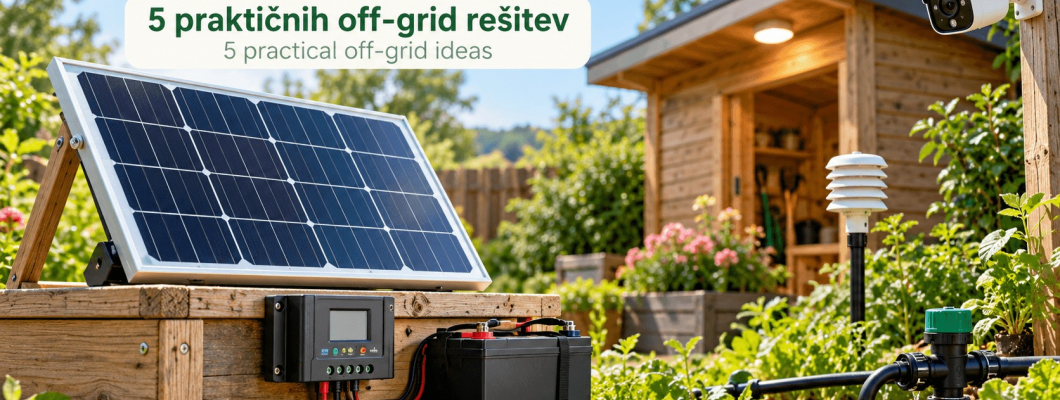
What Can a 30W Solar Panel Power? 5 Practical Off-Grid Projects
Want to light a garden shed, run environmental sensors or charge your phone where there is no electrical outlet? These practical applications do not require a large solar installation.
The compact Cellevia CL-SM30M 30W monocrystalline solar panel provides a starting point for building a small 12V off-grid system. With a suitable charge controller and battery, daytime solar energy can be stored for later use.
Here are five useful applications, practical energy calculations and a simple system wiring concept.

Compact size, practical possibilities
The CL-SM30M uses 36 monocrystalline silicon cells. Its dimensions are 650 × 350 × 25 mm, making it suitable for small frames, sheds, auxiliary buildings and other compact outdoor installations.
The panel has an open-circuit voltage of 22.9V. Charging a 12V battery therefore requires a suitable solar charge controller to manage the charging process correctly.
5 practical ways to use a 30W solar panel
Off-grid lighting for a garden shed
Give a shed or small tool storage building practical lighting without installing a mains electricity connection.
Mount the panel in a sunny position. Place the battery and controller in a suitably protected location and connect a compatible 12V LED light through a correctly protected circuit.
Example consumption: 4W LED × 4 hours = 16Wh per evening.
This gives you useful lighting for tools, storage shelves and working surfaces after sunset.
Remote garden and environmental sensors
A small solar system can supply low-power monitoring equipment, including temperature, soil moisture and water level sensors.
Choose a low-consumption controller or sensor with a compatible DC supply. If wireless communications are required, include the communications module's energy use in the calculation.
Example consumption: 0.5W average × 24 hours = 12Wh per day.
This is a practical way to collect information from locations where mains electricity is not readily available.
Phone charging while camping
At a campsite or remote cabin, the panel can charge a 12V battery during daylight. Stored energy can then be used to charge a phone in the evening.
EA Elektronika's SOL PWM 20A controller includes two USB outputs rated at 5V. Check the phone's charging requirements and the controller's USB current limits.
Example consumption: Delivering 15Wh to a phone may require approximately 18–20Wh from the battery once conversion losses are included.
A battery-backed system means you do not need direct sunlight at the moment you charge the phone.
Solar-powered garden irrigation control
Use solar energy to operate a small irrigation timer and a compatible 12V electrically controlled valve.
The setup may include an electronic timer, switching device and water valve. If a pump is required, its continuous power and starting current must be calculated separately.
Example consumption: timer 0.3W × 24 hours = 7.2Wh; valve 6W × 10 minutes = 1Wh. Combined: approximately 8.2Wh per day.
This approach is particularly interesting for small garden irrigation projects with a suitable water supply.
A low-power remote camera
A small solar system can provide power for an energy-efficient observation camera at a cabin, outbuilding or remote monitoring point.
Select a camera with sufficiently low average consumption and use the correct voltage converter where necessary. The camera must not be connected directly to an incompatible panel voltage.
Example consumption: a camera averaging 1W requires 24Wh per day.
Actual requirements depend on the model, night illumination, data transmission and outdoor temperature.
How much electricity does a 30W panel produce?
The rated power of 30W is measured under standard test conditions. For practical projects, the important quantity is energy measured in watt-hours (Wh), not merely instantaneous power in watts (W).
A simple calculation
30W × 3 equivalent full-sun hours = 90Wh of theoretical daily energy before losses.
With a PWM controller charging a 12V battery, the usable charging power may be lower. At an illustrative charging voltage of approximately 13V, a current of 1.62A and three equivalent sun hours, the result is about 63Wh before additional losses.
Applying an illustrative factor of 75% gives approximately 47Wh of daily stored energy.
This is an example calculation, not a guaranteed daily yield. Real output depends on location, season, shading, orientation, temperature, controller type and battery condition. Winter output can be considerably lower.
Example daily energy requirements
| Application | Calculation | Daily energy |
|---|---|---|
| LED lighting | 4W × 4 hours | 16Wh |
| Monitoring sensor | 0.5W × 24 hours | 12Wh |
| Phone charging | One charge with losses | 18–20Wh |
| Irrigation timer and valve | 7.2Wh + 1Wh | 8.2Wh |
| Low-power camera | 1W × 24 hours | 24Wh |
These figures are illustrative consumption examples, not the specifications of particular appliances. If several devices are used simultaneously, add their daily energy needs, controller consumption and conversion losses.
How to connect the panel, charge controller and battery
A basic off-grid system consists of a solar panel, suitable charge controller, 12V battery and connected electrical load.
Conceptual wiring diagram
Recommended connection sequence
- Mount the controller in a dry, suitably ventilated location.
- Check polarity, battery chemistry and the required charging profile.
- Connect the battery to the controller's BAT terminals first, with a suitable fuse near the positive battery terminal.
- Connect the solar panel to the PV terminals.
- Connect electrical loads according to the controller and device instructions.
- Check the charging indication and verify correct operation.
When disconnecting the system, normally isolate the PV input first, then the loads, and finally the battery, unless the specific controller manual states otherwise.
Choosing the right battery capacity
A battery stores energy for nighttime use and periods of limited sunlight. For example, a 12V 12Ah battery has a nominal energy capacity of:
12V × 12Ah = 144Wh
For conservative planning with a conventional AGM lead-acid battery, approximately 50% depth of discharge can be used as a working assumption to support battery service life.
This provides about 72Wh of planned usable energy before further losses and temperature effects.
Suppose an LED light uses 16Wh per evening and a sensor uses 12Wh daily. The regulator may itself consume up to approximately 4.3Wh per day based on its stated maximum self-consumption.
Total daily demand would be approximately 32.3Wh. In this simplified example, the battery could provide roughly two days of operation without additional solar charging.
Additional reserve is advisable where low temperatures or several cloudy days are expected.
Where should you install the panel?
- Choose an unshaded location. Avoid nearby trees, fences and roof edges that regularly cast shadows.
- Consider south-facing orientation. In the Northern Hemisphere this is generally a useful starting point for annual solar production.
- Adjust the tilt. The most suitable tilt depends on season and local conditions. Winter sunlight is important for year-round installations.
- Use a secure mounting structure. The frame must withstand expected environmental and wind loads.
- Protect electrical connections. Choose suitable PV wiring, connectors and cable strain relief.
- Keep the surface reasonably clean. Remove significant dirt and leaves according to manufacturer guidance.
Build your setup with EA Elektronika products
- CL-SM30M – 30W solar panel. The main energy source for compact off-grid applications. View the solar panel
- SOL PWM 20A – solar charge controller. Automatic 12/24V detection, LCD screen and two USB outputs. The 20A rating is the controller's upper current capability, not the current produced by the 30W panel. View the controller
- 12V 12Ah AGM battery. An example storage battery for nighttime and low-sunlight operation. View the battery
- SOLSET20 – solar connector set. Designed for compatible PV cables with 2.5–4 mm² conductors and properly crimped connections. View the connector set
- CL-SM50M – 50W solar panel. A higher-power alternative where energy demand or charging reserve needs to be increased. View the 50W panel
Include suitable wiring, mounting hardware, fuses and correct device voltage requirements when planning the complete installation.
Frequently asked questions
Can I connect a phone directly to the panel?
Not directly. A phone needs a regulated USB supply or suitable voltage conversion. A battery-backed setup also allows convenient evening charging.
Can a 30W panel charge a 12V battery?
Yes, through a solar charge controller compatible with the battery voltage and chemistry.
Does it generate electricity on cloudy days?
Solar cells can produce electricity from diffuse daylight, although the available output is generally lower.
Do I need a 230V inverter?
Not for compatible 12V DC loads or suitable USB-powered devices. Direct low-voltage systems are usually simpler and avoid inverter losses.
Can I power several devices simultaneously?
Yes, provided the controller, battery, wiring and outputs support the combined current and energy demand.
Is 30W suitable for year-round use?
It depends on the load and location. Very low-power sensors may be suitable, while larger year-round loads require careful winter energy planning.
Conclusion: start with a practical small solar project
A 30W solar panel can become the foundation for several useful projects: garden shed lighting, remote monitoring, phone charging, irrigation control and low-power cameras.
By combining the correct solar controller, battery and daily energy calculation, you can build a straightforward off-grid system that can be adapted to your needs.
Build your solar setup with EA Elektronika
Choose the Cellevia CL-SM30M 30W solar panel and combine it with a suitable controller, battery and connection accessories.
Start with the application that matters to you, from a simple garden light to an independent sensor system.
EXPLORE THE 30W PANEL EXPLORE SOLAR EQUIPMENTTechnical references
CL-SM30M technical specifications: Cellevia Power CL-SM30M data sheet . Controller, battery and connector specifications: EA Elektronika product listings. Energy calculations are illustrative examples, not measured daily panel output.


