IR Heating and Network Charges: November 2026 and the Changes in January 2027
Two figures matter when you run an infrared panel. kWh tells you how much electricity it used over time. kW tells you how much power appliances drew at the same time. Slovenian network charges include both an energy component and a billed-power component. Moving heating to another hour therefore does not automatically produce a large saving on the entire electricity bill.
This guide concerns Slovenia's network-charge system and reflects official information available on 12 October 2026. We first set out the dates and then work through an example using 400 W and 850 W IR panels.
First, the dates: November 2026 is different from January 2027
| Period | Which schedule applies? | Why it matters for heating |
|---|---|---|
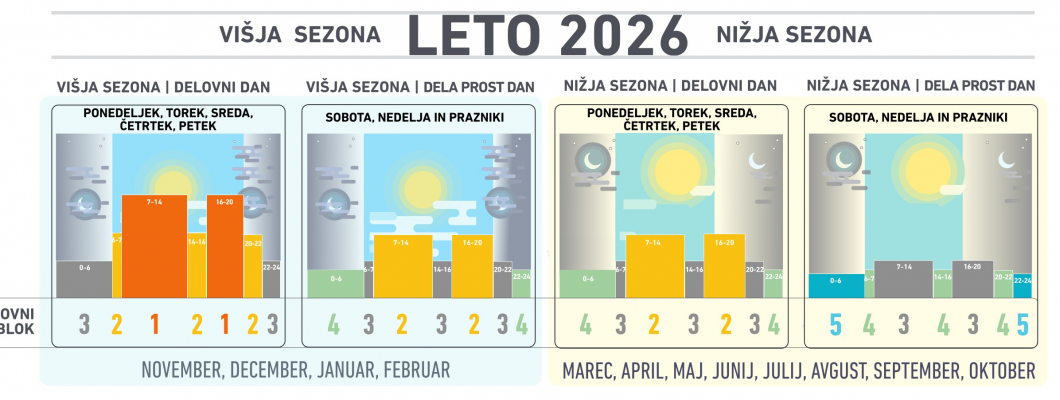
| November and December 2026 | Official 2026 time blocks | The higher season begins. Block 1 occurs on working days; the most expensive periods run from 07:00 to 14:00 and 16:00 to 20:00. |
| January and February 2027 | New official 2027 time blocks | The higher season continues, but the schedule changes. Block 1 falls on working days from 06:00 to 12:00 and 17:00 to 20:00. |
The key distinction: the 2027 schedule does not begin in November 2026. Do not simply copy a November heating timetable into January. Block 1 does not occur on non-working days; consult the complete official tables for 2026 and 2027 for the other blocks.
kWh and kW answer different questions
Energy, measured in kWh: an 850 W panel is rated at 0.85 kW. If it runs continuously for three hours, it uses approximately 2.55 kWh. Actual energy use is lower if its temperature control switches it off for part of that period. The network energy component relates to electricity drawn from the grid in the relevant time blocks.
Power, measured in kW: a 400 W panel and an 850 W panel operating together have a combined rated load of 1.25 kW. Billed power concerns the measured 15-minute power of the entire metered premises, including other appliances—not only the IR panels.
Power × time = energy: 1.25 kW × 0.25 h = 0.3125 kWh in 15 minutes.This assumes both panels run at their full rated power for the entire 15 minutes. It does not tell you the agreed billed power shown on your bill.
Example: two panels, an oven and a kettle running together
Assume that during the same 15-minute interval a 400 W panel, an 850 W panel, an oven drawing 2.0 kW and a kettle drawing 2.0 kW run continuously. This is a simplified illustration: real ovens and kettles may switch their heating elements on and off or run for less than 15 minutes.
0.40 + 0.85 + 2.00 + 2.00 = 5.25 kW; over 15 minutes, that is 1.3125 kWh.If the agreed billed power for the relevant time block were 4.1 kW, the measured power in this simplified interval would be 1.15 kW above it. This is not an automatic charge for “1.15 extra kWh”. It is a power comparison. The treatment of excess power depends on the rules and on whether you changed the power set by the distribution operator yourself.
Running the oven and kettle at separate times could reduce the simultaneous peak. If the panels still heat for the same total time, rearranging appliance use does not make their kWh disappear. A room thermostat also does not, by itself, monitor the whole household's 15-minute power.
What does the 70% Block 1 power tariff mean?
From 1 November 2026 through February 2027, 70% of the tariff for billed power in Block 1 is charged. For Slovenian user group 0, the published reduced November–December 2026 tariff is EUR 2.67611 per kW per month, before taxes and other charges.
That is not a price per kWh or the price of the entire electricity bill. At this tariff, an illustrative 1 kW increase in agreed Block 1 power would mathematically add about EUR 2.68 per month to this component alone, before taxes. Other time blocks and energy charges also apply. Reducing agreed power without checking your actual peaks can lead to excess-power charges.
No January 2027 price is quoted here: the agency says 2027 network tariffs will be published at the end of November 2026. The 70% rule also applies in January and February 2027, using the tariffs valid then.
What does moving one hour of heating actually save?
For user group 0, the published November–December 2026 network energy tariff is EUR 0.02217/kWh in Block 1 and EUR 0.01717/kWh in Block 3—a difference of EUR 0.005 per kWh before taxes. Suppose an 850 W panel runs at full power for exactly one hour in either case and that hour can genuinely be moved from Block 1 to Block 3. The difference in this component alone is:
0.85 kWh × (0.02217 − 0.01717 EUR/kWh) = EUR 0.00425.That is less than half a euro cent of network energy charges for this example hour. It excludes the electricity supplier's price, taxes, any effect on billed power, thermostat cycling and possible reheating after a room cools. It is therefore not a promise of a particular monthly saving.
A practical way to set up IR heating
- Read your bill. Note the agreed billed power for each block and any reported exceedances.
- Check the applicable block. Use the agency's live tariff indicator and the separate 2026 or 2027 schedule.
- Heat according to room use. Do not leave an occupied, cold room unheated merely to follow a tariff if comfort suffers or you must later replace the lost heat.
- Watch simultaneous loads. Where practical, avoid running several heaters and other major appliances together at high-load times. A normal room thermostat will not coordinate the whole home.
- Change agreed power carefully. Examine measured 15-minute peaks and the excess-power rules before requesting a lower setting.
How EA products relate to this guide
The Infraboost 400 W and Infraboost 850 W are the real EA models used in our kW and kWh examples. EA lists WiFi control, a remote and wall-mounted or freestanding use with supplied stands for these models. Choose the required panel output according to insulation and actual room heat loss.
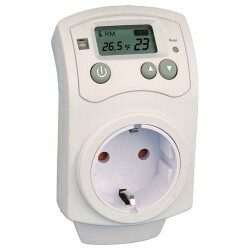
The Infraboost TH-810 plug-in thermostat offers simple temperature control for a suitable heater connected to its socket. It does not measure whole-home billed power or automatically coordinate appliances with Slovenia's official time blocks. Check its permitted load, the particular panel's controls and both products' instructions before combining them; a panel with built-in control does not automatically need a second thermostat.
Frequently asked questions
Does an 850 W panel always cost more in network charges than a 400 W panel?
At the same continuous run time it uses more kWh and contributes more to simultaneous power. Your bill also depends on thermostat cycling, other appliances, time blocks, agreed power and the electricity supply contract.
Does Block 1 apply at weekends?
No. The official schedule places Block 1 only on working days in the higher season. Check the relevant year's table for the other blocks.
Does every power exceedance produce a surcharge?
Not necessarily. According to the agency, excess-power charges are not billed if the customer has not changed the power set by the distribution operator; exceedances are still reported. Different treatment applies after a customer changes their agreed power.
Will January 2027 have November 2026's prices?
Do not assume so. The new blocks start in January, while the 2027 tariffs have not yet been published.
Conclusion: check two measurements and two calendars
With IR heating, monitor kWh for electricity consumed and 15-minute kW for simultaneous load at the metered premises. Use the 2026 schedule in November and December; switch to the new schedule in January 2027. Set heating around comfort and actual readings, and do not lower agreed power using the rating of just one panel.
Official sources: 2026 blocks, 2027 blocks, network tariffs and excess-power rules.