Rats in Slovenian cities: what should you do when you see them near home?
In September 2026, Slovenian media again reported rats near restaurants and waste bins on Petkovškovo nabrežje in Ljubljana. Residents also reported their return to Miklošič Park in May. These are documented local observations, not evidence that rat numbers are rising in every Slovenian city.
For residents, the more useful question is practical: is a rat merely crossing a public area, or has it found food, water and shelter right next to the building? That determines whether the surroundings need tidying or the building manager and professional pest control should be involved.
Why do rats stay near bins and buildings?
Rats exploit available food, water and cover. Scraps beside an overflowing bin, food left out for wildlife, exposed pet food, and openings around drains or pipes all create favourable conditions. In reporting about Ljubljana, Slovenia’s public health institute, NIJZ, stressed tidy collection points, proper waste handling and keeping food waste out of toilets. Capturing one animal does not remove a continuing food source.
Rats may be present throughout the year. There is no reason to wait for winter: a repeatedly used route between a bin and a basement door calls for an inspection. Conversely, one photograph of a rat in a public area does not prove that it is nesting in your apartment.
First principle: remove access to food and address entry points before expecting trapping to have a lasting effect.
The first 24 hours: observe, record, correct
- Record the location. Note the date, time and place. Photograph droppings, damaged packaging or openings if you can do so without direct contact.
- Remove attractants. Close waste in the appropriate bin, clear food scraps, and take pet bowls in after feeding. Report damaged or overflowing shared bins to the building manager or waste service.
- Check access. Inspect door bottoms, ventilation openings, pipe penetrations, drains and floor-to-wall joints. Seal significant openings properly, but check that rodents are not already trapped inside the structure.
- Assign responsibility. In shared spaces, involve the building manager. Report public sewers and municipal land to the relevant service. For repeated signs, several animals or a food business, contact a professional pest control provider.
Example: if rats appear at a waste collection point shared by several apartment blocks, one private trap in one basement cannot replace bin repairs and coordinated action.
How do you know it is more than one passing visit?
Fresh droppings appearing after cleaning, damaged food packaging, gnaw marks, sounds in a wall and repeated sightings on the same route indicate activity worth tracking. Do not reach into openings or nests with bare hands. If you find signs in a pantry, discard food that might be contaminated and change how it is stored.
Distinguish the public problem from an enclosed private space. The municipality addresses public waste and infrastructure; the owner or manager addresses the building. One device cannot solve a neighbourhood-wide problem.
Health: take care without exaggerating the risk
Rats are an important reservoir for leptospirosis. NIJZ explains that infected animals can shed the bacteria in urine and contaminate water or soil. NIJZ also lists mice, voles and rats among natural hosts of hantaviruses that cause haemorrhagic fever with renal syndrome, known in Slovenia as “mouse fever”; increases in human cases there are usually associated especially with mice and related rodents. A sighting does not establish that a particular rat is infected.
When cleaning a space with droppings, wear gloves and follow NIJZ guidance: ventilate the room, do not dry-sweep or vacuum droppings, disinfect affected surfaces first, then wipe them up. Wash your hands after removing gloves. Extensive contamination calls for specialist planning.
When does the RATMAN MK08 make sense?
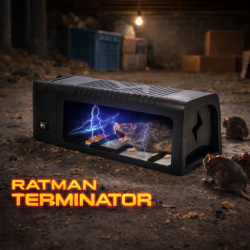
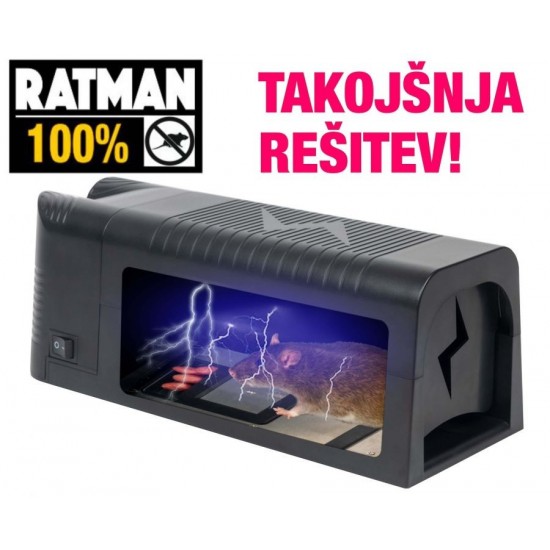
The RATMAN M8 TERMINATOR, model MK08, is a rechargeable electronic mouse and rat trap. It uses a high-voltage mechanism in an enclosed chamber and needs neither rodenticide nor glue. EA specifies status LEDs, a replaceable 18650 battery and placement beside a wall on a known rodent route.
It is a tool for removing individual rodents in a controlled area, such as a basement, pantry or garage. It is not intended as a city-wide answer or for unguarded placement on a pavement or by public bins.
- First remove competing food sources and identify the route.
- Set the trap on a stable, dry surface beside the wall where activity has been seen. Use a small amount of bait as directed.
- Keep children and pets away. Do not touch the internal metal plates.
- Check the indicators; empty, clean and recharge only according to the supplied instructions. Wear gloves when removing a catch.
A particular number of catches or fixed time to resolution cannot be promised. Results depend on placement, food control and the extent of the infestation.
A plan for an apartment block or restaurant
In an apartment block, the manager should collect observations by floor and address the bin area, basement doors and service openings. Residents should not place uncoordinated traps in shared areas. A restaurant owner should review waste storage and food stock and document measures under its hygiene plan.
If signs persist, have a specialist assess the whole area and coordinate control. Afterwards, monitor whether new droppings appear, whether food remains accessible, whether openings stay closed and whether sightings recur. One rat-free night is not proof that the problem is solved.
Frequently asked questions
Should I place a trap beside a public bin? No. Report the public area to the relevant service; use the electronic trap in a controlled location according to its instructions.
Does MK08 replace better waste handling? No. Accessible food will keep attracting rodents.
Does every rat carry disease? You cannot infer infection from a sighting. Still avoid contact with waste and clean safely.
When should I call a specialist? For recurring evidence, multiple animals, inaccessible nests or a food business.
Conclusion: remove the food source, then address activity
Ljubljana reports from 2026 show how readily rats exploit food around bins. Inspect your building, manage waste and openings, clean evidence safely and involve the building manager or pest control provider when needed. Where you control an enclosed space and know the rodent route, RATMAN MK08 can be part of that plan. A lasting response combines measures; no single trap can promise it.
Sources: Dnevnik, 9 September 2026; Dnevnik, 13 May 2026; NIJZ on leptospirosis; NIJZ on hantavirus.