Rats: how they live, what signs they leave and how to limit a problem
People often notice a rat only after it has found a route to food or shelter. Catching one animal is therefore not a complete plan. You need to check what attracts it, where it enters and whether fresh signs continue to appear.
This guide explains rat behaviour, contamination risks and a practical sequence of steps for a home, basement, warehouse or business. If rats are on public land or throughout an apartment building, involve the appropriate service or building manager.
Which rats might you encounter?
The best-known species around people are the brown or Norway rat (Rattus norvegicus) and the black or roof rat (Rattus rattus). A brief sighting may not establish the species. For the first building inspection, it matters more to locate food, water, cover and entry points.
Rats can move beside walls, through vegetation, around waste bins and near drains or service areas. They can climb or swim, but that does not mean every rat came from a sewer or will enter through a toilet. An unusual entry route should be assessed in the particular building.
Why can a small problem grow?
Rats can reproduce quickly when conditions are favourable. The rate depends on food, water, shelter, temperature and survival of the young. A claim that one pair will necessarily produce “thousands of descendants” is a theoretical calculation, not a forecast for an individual house.
A more useful question is: do fresh signs reappear after safe cleaning? New droppings, damaged packaging or repeated movement on the same route over the following days point to continuing activity. Record the place and time rather than guessing the number of animals from one sign.
Five signs worth checking
- Droppings and urine marks: especially along walls, behind appliances, in a pantry or on shelves. Avoid bare-hand contact.
- Damaged food: gnawed packaging or scattered feed. Discard food that might have been contaminated.
- Gnawing: on wood, plastic, insulation or cables. Have damaged electrical wiring checked by a qualified person.
- Routes and openings: near doors, pipes, ventilation, drains and building joints.
- Recurrence: new evidence after cleaning tells you more about current activity than one old dropping.
Example: if food packaging in a pantry has been damaged, discard exposed food, clean the area safely, check the opening behind the pipe and watch for fresh signs over the next few days.
What are the risks to people and buildings?
Rats can contaminate food and surfaces with urine and droppings. Slovenia’s public health institute, NIJZ, identifies them as an important reservoir for bacteria that cause leptospirosis; contact with infected animals or a contaminated environment can lead to infection. NIJZ also lists rats among the hosts of hantaviruses that cause haemorrhagic fever with renal syndrome, often called “mouse fever” in Slovenia. Increased human case numbers there are usually associated mainly with mice and similar rodents. Seeing one rat does not establish infection.
Gnawing can damage packaging, insulation and wiring. If you find a damaged electrical cable, stop using the affected equipment until a qualified person checks it. In food preparation areas, schools or other institutions, follow the applicable hygiene procedures as well.
Cleaning droppings and dead rodents safely
Do not dry-sweep or vacuum droppings. That can raise contaminated dust into the air. NIJZ advises ventilating a space that has been closed for a long time, wearing gloves, disinfecting contaminated surfaces before collecting droppings, and washing hands thoroughly afterwards. Follow the disinfectant instructions and NIJZ guidance for disposing of disinfected droppings or dead rodents.
For extensive contamination, inaccessible nests or a sensitive business area, involve a professional service. Do not empty a trap with bare hands. Do not assume that burying a carcass is the correct disposal method; follow local waste instructions and the product manual.
First remove what attracts rats
- Store food and animal feed in closed containers; do not leave pet food accessible overnight.
- Close waste bins and place rubbish inside them rather than beside them. Report or safely remove scattered food at a collection point.
- Reduce clutter in basements and garages, particularly against walls where it prevents inspection.
- Check openings around pipes, doors and ventilation. Seal them appropriately, but first consider whether animals are already inside the structure.
- Watch the same locations for several days after cleaning. Recording fresh signs helps show whether the measures are working.
If the food source is a shared waste area or the problem spans several apartments, the building manager or relevant municipal service should coordinate action. One device in one pantry cannot remove a shared food source.
M8 and RATMAN PRO: different roles
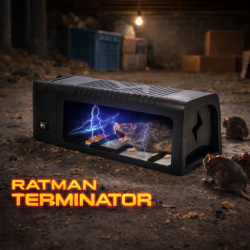
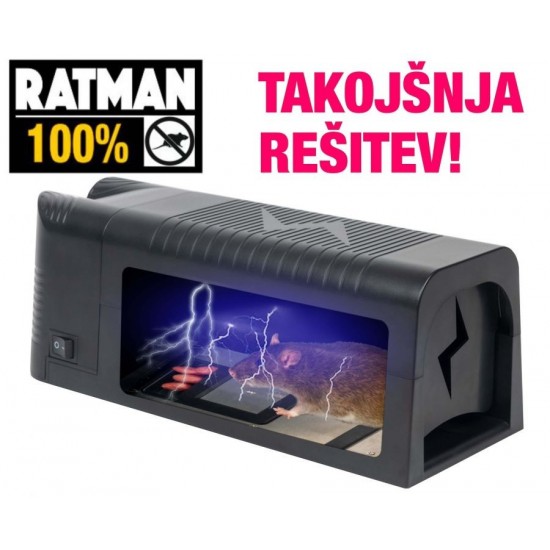
The RATMAN M8 TERMINATOR (MK08) is an electronic trap for mice and rats. It is intended to remove a rodent directly in a controlled space. EA lists an enclosed chamber, a high-voltage mechanism, a rechargeable battery and LED status indicators. Place it on an observed route beside a wall, use bait as instructed and keep children and pets away. Wear gloves when emptying it and follow the supplied manual.
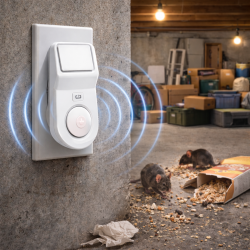
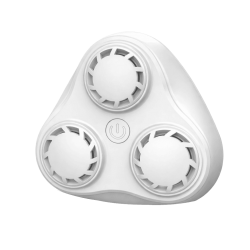
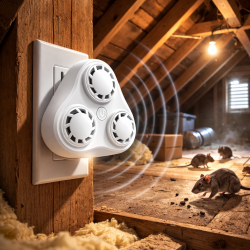
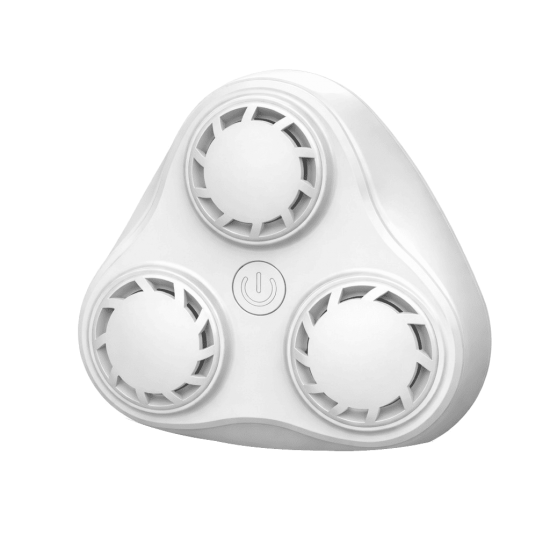
RATMAN PRO is an ultrasonic repeller for use in a room. EA lists three speakers, changing frequencies and a stated reach of up to approximately 250 m² of open space. Walls, furniture and enclosed recesses reduce sound propagation. You can test it as a supplement to other measures, but switching it on does not prove that entry points are sealed or that rodents are gone. Watch for new signs.
Practical choice: for confirmed activity on an accessible basement route, consider M8 while removing food sources. If testing a repeller in a suitable open area, judge RATMAN PRO by the actual evidence over time. Neither product replaces sealing, hygiene or professional pest control for a larger infestation.
When is a professional inspection needed?
Bring in a specialist if fresh droppings continue after cleaning and food control, if several animals are seen, if the nest is inaccessible, or if a food preparation area is affected. The same applies when shared spaces are involved and an individual resident cannot address the whole problem. A professional inspection can connect signs, entry points and environmental conditions into one plan.
Frequently asked questions
Does one sighting prove there is a colony? No. It does justify checking food, openings and fresh signs.
Can I rely only on a repeller? Do not expect it to remove food or seal a hole. Assess results by looking for fresh evidence.
Is M8 suitable for a public area? No. Use it according to its instructions in a controlled location inaccessible to children and pets.
How do I know the measures are working? After safe cleaning, check for new droppings, damage or sightings. Arrange professional help if the activity continues.
Conclusion
Start with the cause: food, water, shelter and entry points. Clean evidence safely, monitor the area and choose a suitable tool. RATMAN M8 is an option for direct removal in a controlled space; RATMAN PRO can be a supplementary repeller test when positioned appropriately. For recurring or extensive activity, involve professional pest control.
Sources: NIJZ on leptospirosis; NIJZ on hantavirus and cleanup; CDC on identifying and controlling rodents.