1.5A or 8A? How to choose the right battery charger
A more powerful charger is not automatically a better charger. Excessive current for a small battery may cause overheating, gassing or premature ageing. A charger that is too weak may take a very long time to charge a larger battery or fail to finish within the available period.
Before connecting a charger, check four values: battery chemistry, nominal voltage, capacity in Ah and maximum permitted charging current. Only then should charger features be compared.
Short answer
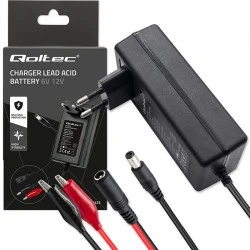
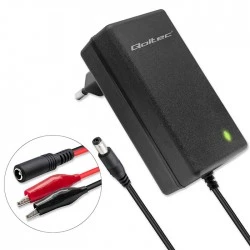
The 1.5A Qoltec 52423 is intended for smaller compatible 6V and 12V AGM, GEL and STD lead-acid batteries when the battery data sheet permits a 1.5A current.
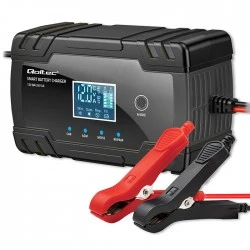
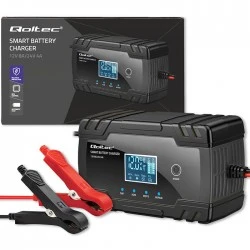
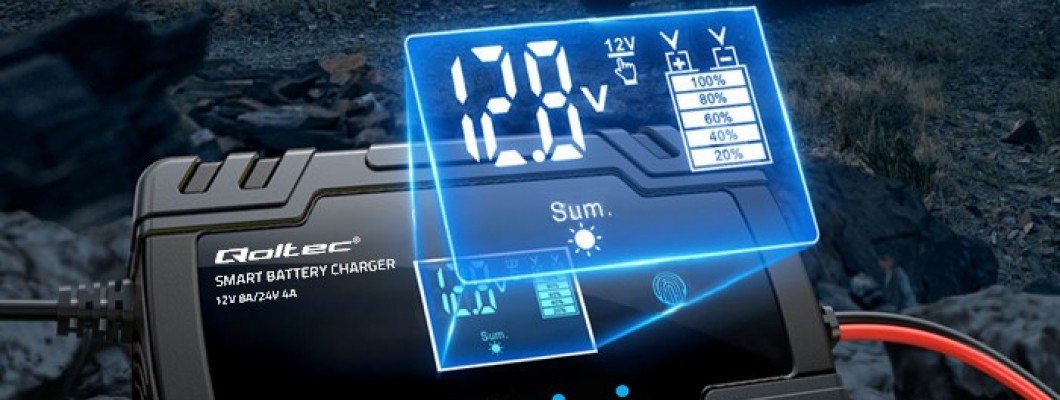
The Qoltec 52490 provides up to 8A at 12V or 4A at 24V. It is more suitable for larger compatible lead-acid batteries when the permitted voltage and current are confirmed by their documentation.
Neither charger is intended for ordinary lithium, Li-ion or LiFePO4 batteries. A lithium battery requires a charger and charging profile specifically approved for that chemistry.
Four values to check before buying
1Chemistry
AGM, GEL, WET, EFB, STD and lithium batteries do not use identical charging profiles. A matching “12V” marking therefore does not prove compatibility.
The Qoltec 52423 supports AGM, GEL and STD lead-acid batteries. The Qoltec 52490 supports several lead-acid types, but it is not specified for LiFePO4.
2Nominal voltage
A 6V battery requires a 6V charging mode, a 12V battery a 12V mode, and a 24V battery a 24V mode. Selecting the wrong voltage can damage the battery or charger.
Read the voltage from the battery case or data sheet. Do not infer it from physical size or the number of terminals.
3Capacity in Ah
Capacity describes how much electrical charge the battery can store. A 36Ah battery generally needs more time or more current than a 7.2Ah battery.
Capacity alone does not establish the permitted current. The battery manufacturer determines the final limit.
4Maximum initial current
Look for “maximum initial current”, “initial charging current” or similar wording in the data sheet. The charger must not exceed this limit.
If the value cannot be confirmed, do not assume that the highest available current is safe. Use a conservative option or obtain the correct specification.
Qoltec 52423 versus Qoltec 52490
| Feature | Qoltec 52423 | Qoltec 52490 |
|---|---|---|
| Battery voltage | 6V or 12V | 12V or 24V |
| Maximum charging current | 1.5A | 8A at 12V; 4A at 24V |
| Supported chemistry | AGM, GEL and STD lead-acid batteries | AGM, GEL, EFB, WET, SLA, DRY and other lead-acid types listed in the manual |
| Status display | Red or green LED | LCD showing voltage, current, mode and status |
| Charging process | Automatic charging control | Three-stage CC, CV and Float process |
| Repair mode | Not listed as a main function | Yes; approximately 16-hour recovery programme |
| Typical selection | Smaller compatible batteries that permit 1.5A | Larger 12V or 24V batteries that permit the corresponding output current |
| Li-ion or LiFePO4 | No | No |
How can charging time be estimated?
A basic estimate uses the missing capacity, charging current and a factor for losses. For planning lead-acid battery charging, an approximate factor of 1.3 can be used:
If a 36Ah battery is approximately 50% charged, around 18Ah is missing. With a maximum 8A charging current:
This is only a planning estimate. An automatic charger reduces current during the later constant-voltage stage. Battery temperature, age and condition may extend the actual time. Charger completion status takes priority over the calculation.
| Example | Assumption | Planning estimate | Important limitation |
|---|---|---|---|
| 12V / 7.2Ah with 1.5A | Battery is approximately 50% charged | 3.6 ÷ 1.5 × 1.3 ≈ 3.1 hours | The data sheet must permit 1.5A. |
| 12V / 36Ah with 8A | Battery is approximately 50% charged | 18 ÷ 8 × 1.3 ≈ 2.9 hours | Current tapering may make the actual time longer. |
| 24V / 60Ah with 4A | Battery is approximately 50% charged | 30 ÷ 4 × 1.3 ≈ 9.8 hours | The 24V configuration and permitted current must be confirmed. |
| Fully discharged 36Ah battery with 8A | Theoretically missing 36Ah | 36 ÷ 8 × 1.3 ≈ 5.9 hours | Deep discharge may indicate damage; the calculation does not prove that the battery remains serviceable. |
Four practical scenarios
1. Small 6V / 4.5Ah AGM battery
The Qoltec 52423 supports 6V and AGM chemistry. However, 1.5A divided by 4.5Ah is approximately 0.33C. The maximum initial current for the exact battery must therefore be checked before use. Matching voltage and AGM chemistry alone are not enough.
2. 12V / 7.2Ah AGM battery in an alarm or backup system
A 1.5A current is approximately 0.21C. If the battery data sheet permits at least 1.5A, the smaller automatic charger can be a practical option. Disconnect the battery from the system first whenever required by the equipment instructions.
3. 12V / 36Ah Deep Cycle AGM battery
Charging a larger battery at 1.5A would take considerably longer. At 12V, the Qoltec 52490 can provide up to 8A and reduce the current during its multi-stage cycle. The battery data sheet must still permit the selected profile and current.
4. A 24V system
A 6V/12V charger is not suitable for a 24V battery or correctly assembled 24V battery bank. The Qoltec 52490 supports 24V at up to 4A. Confirm that the manufacturer permits the complete bank to be charged as one 24V unit.
What can repair mode actually do?
The Qoltec 52490 includes an approximately 16-hour repair programme intended for some deeply discharged or sulphated lead-acid batteries. It may help only with certain chemical conditions.
Repair mode cannot correct:
- a cracked or deformed case;
- an internal short circuit;
- broken plates or terminals;
- electrolyte leakage;
- a frozen battery;
- a battery that becomes unusually hot or produces a strong odour.
Do not start charging when any of these signs are present. If they appear during charging, stop the process safely.
A safe connection sequence
- Read the charger and battery instructions and confirm chemistry, voltage and permitted current.
- Check that the case has no bulging, cracks, leakage, damage or signs of freezing.
- Keep the charger disconnected from the mains supply.
- Unless the manual states otherwise, connect the red clamp to positive and the black clamp to negative.
- Check that the clamps are secure, then connect the charger to the mains.
- Select the correct voltage and battery mode.
- Monitor temperature, the battery case and the charger display during charging.
- After charging, disconnect the mains supply first, then remove the black clamp followed by the red clamp.
Do not charge without adequate ventilation
Lead-acid batteries may release hydrogen and oxygen during charging. Charge in a ventilated area away from sparks, flames, cigarettes and hot surfaces. Do not place the charger directly on top of the battery.
Never charge a damaged, swollen, frozen or leaking battery. Use eye protection and follow the manufacturer's safety instructions.
Which EA products are connected to this article?
| Product | Role in the article | Why is it connected? |
|---|---|---|
| Qoltec 52423, EA code 83044 | Compact 1.5A charger | Example for smaller compatible 6V and 12V AGM, GEL or STD lead-acid batteries. |
| Qoltec 52490, EA code 83012 | 12V/8A or 24V/4A charger | Example of a more powerful three-stage charger for larger compatible lead-acid batteries. |
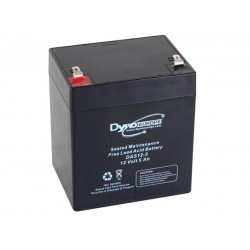
| 12V / 4.5Ah AGM, EA code 83110 | Small-battery example | Demonstrates why maximum initial current must be checked in addition to voltage. |
| Nerbo NBC36-12i 12V / 36Ah, EA code 83038 | Larger Deep Cycle AGM example | Used for the practical charging-time calculation with a higher charging current. |
Frequently asked questions
Can I use an 8A charger with every 12V battery?
No. A matching 12V rating is not enough. Check battery chemistry and maximum permitted initial current. Eight amps may be far too much for a small battery.
Is a weaker charger always safer?
Not necessarily. An excessively low current can make charging impractically slow, while an incorrect charging profile can damage a battery regardless of current. The correct profile and data-sheet compliance are essential.
Can an AGM charger charge a LiFePO4 battery?
No, unless the charger includes a dedicated LiFePO4 programme and the battery manufacturer permits it. The Qoltec 52423 and 52490 are not specified as LiFePO4 chargers.
Does the calculation give an exact charging time?
No. It is a planning estimate. An automatic charger reduces current during the final stage, so the actual time is often longer.
Why will the charger not start with a deeply discharged battery?
Some automatic chargers require a minimum detected voltage. Extremely low voltage can also indicate damage. Do not attempt to “wake” the battery using an improvised parallel connection to another battery.
Can the battery be left unattended?
This is not recommended. Even with an automatic charger, regularly check temperature, odour, case condition, cables and the charger display.
Check the battery before choosing the charger
The correct choice does not begin with the highest ampere rating. It begins with the battery label: chemistry, voltage, capacity and maximum permitted charging current.
The 1.5A Qoltec 52423 may suit smaller compatible lead-acid batteries. The 8A/4A Qoltec 52490 may be more appropriate for larger 12V or 24V batteries—but only within the limits of the exact battery.
Sources and further reading
- Qoltec – model 52423 operating instructions
- Qoltec – model 52490 instruction manual
- Yuasa – lead-acid battery technical manual
- CCOHS – lead-acid battery charging safety
Sources and links checked on 6 October 2026. Documentation supplied with the exact battery and charger always takes priority.