- Stock: In Stock
- Model: ARDUINO-UNOR4MINIMA

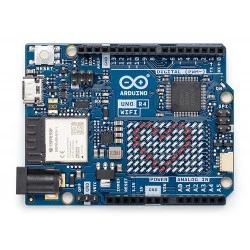
Arduino UNO R4 Minima – 32-Bit Development Board with Arm Cortex-M4 and USB-C
The classic Arduino UNO form factor with a much more powerful 32-bit processor, more memory, USB-C, DAC, RTC, CAN bus and 5 V logic.
Arduino UNO R4 Minima is the modern next generation of one of the most popular Arduino development platforms. The classic 8-bit UNO concept has been upgraded with a 32-bit Renesas RA4M1 microcontroller featuring an Arm Cortex-M4 core running at 48 MHz.
The board retains the familiar UNO form factor, 5 V operating voltage and standard pin layout, while providing substantially more processing power, more memory and new peripheral functions.
This makes it an excellent choice for learning electronics and programming as well as more advanced automation, measurement, control, robotics and prototyping projects.
Why Choose Arduino UNO R4 Minima?
- 32-bit Arm Cortex-M4 processor – more processing power for advanced algorithms, measurements and control applications.
- 48 MHz operating frequency – a significant performance increase compared with traditional 16 MHz UNO boards.
- 256 kB Flash memory – more space for program code and more complex projects.
- 32 kB SRAM + 8 kB EEPROM – more memory for working data and storing settings.
- USB-C connector – a modern connection for programming and powering the board.
- 5 V operating voltage – maintains compatibility with much of the classic Arduino UNO ecosystem.
- Up to 24 V input via VIN – a wider power-supply range for different applications.
- DAC, RTC, CAN and HID – features that often required additional hardware in older UNO projects.
Renesas RA4M1 – a Major Step Forward for the UNO Platform
At the heart of the board is the Renesas RA4M1 with a 32-bit Arm Cortex-M4 core and an integrated floating-point unit.
The processor operates at 48 MHz, enabling faster code execution and significantly more possibilities for projects involving measurements, data processing or responsive control.
UNO R4 Minima therefore remains accessible enough for beginners while offering considerably more headroom for advanced projects.
More Memory for Larger Projects
The more powerful processor is accompanied by a substantial increase in available memory:
- 256 kB Flash for program code,
- 32 kB SRAM for working data,
- 8 kB EEPROM for non-volatile data storage.
This allows more complex programs, more libraries and more space for variables and data than older 8-bit UNO platforms.
Classic UNO Pin Layout – Now with a More Powerful Core
UNO R4 Minima retains the familiar Arduino UNO pin layout, making migration from many older UNO projects easier.
- 14 digital I/O pins – D0 to D13,
- 6 analogue inputs – A0 to A5,
- 6 PWM outputs – D3, D5, D6, D9, D10 and D11,
- UART communication,
- SPI communication,
- I²C communication,
- CAN bus support with an additional external CAN transceiver.
The board uses 5 V logic levels, helping maintain compatibility with many existing Arduino accessories and modules.
Higher-Resolution Analogue Measurements and a True DAC Output
Arduino UNO R4 Minima also introduces important improvements for analogue applications.
- ADC resolution up to 14 bits enables more precise analogue measurements.
- 12-bit DAC allows generation of a true analogue output voltage.
- Integrated operational amplifier further expands the possibilities for analogue applications.
- Capacitive touch sensing enables additional user-interface and sensing projects.
The DAC is particularly useful for audio projects, signal generation, analogue control and other applications where PWM is not the ideal solution.
USB-C and HID – Arduino Can Act as a Keyboard or Mouse
UNO R4 Minima uses a modern USB-C connector for programming and power.
Integrated USB functionality also supports HID emulation, allowing the Arduino to operate as a keyboard or mouse.
This opens up possibilities for custom controllers, control panels, keyboards, simulator interfaces, macro controllers and other USB devices.
Integrated Real-Time Clock – RTC
The microcontroller also includes an integrated RTC – Real-Time Clock, which can be used for time- and date-dependent applications.
RTC functionality is useful for data logging, automation, timers, alarms and projects that need to perform specific functions at defined times.
CAN Bus for Automation and Device Communication
UNO R4 Minima also includes microcontroller support for CAN communication.
CAN is widely used in automation, vehicles, industrial systems and other applications where reliable communication between multiple devices is important.
Note: an additional external CAN transceiver is required for the physical connection to a CAN bus.
Flexible Power Supply – USB-C or 6–24 V VIN
The board can be powered directly through the USB-C connector at 5 V or through the VIN / DC input.
The recommended input-voltage range via VIN is 6–24 V, making the board suitable for projects where a higher supply voltage is available.
The power section also includes reverse-polarity and overvoltage protection.
UNO Form Factor and 5 V Logic – Easier Migration from Older Projects
One of the key advantages of the R4 Minima is that despite its new 32-bit architecture it retains the classic Arduino UNO form factor and 5 V operating voltage.
This allows the use of many existing UNO shields, modules and accessories and makes upgrading older projects easier.
Important: because UNO R4 uses a 32-bit Arm microcontroller instead of the older AVR architecture, some older libraries or software may require an updated version compatible with UNO R4.
Minima – for Projects That Do Not Require Wireless Connectivity
UNO R4 Minima is the streamlined version of the UNO R4 family and is an excellent choice when you need a powerful microcontroller, GPIO, analogue inputs, DAC, CAN, RTC and USB but do not require integrated WiFi or Bluetooth.
Less additional hardware means a clean and straightforward development platform for traditional microcontroller projects.
What Projects Is Arduino UNO R4 Minima Suitable For?
- Learning programming and electronics – an excellent platform for schools, courses and home projects.
- Automation – controlling relays, motors, valves, lights and other devices.
- Sensor systems – acquiring analogue and digital measurements.
- Robotics – controlling motors, sensors and user interfaces.
- CAN projects – communicating with other devices when used with an external CAN transceiver.
- USB HID projects – building keyboards, controllers and other input devices.
- Audio and analogue projects – thanks to the integrated 12-bit DAC.
- Prototyping – rapid development of custom electronic solutions.
Arduino UNO R4 Minima Technical Specifications
- Model: Arduino UNO R4 Minima
- Arduino SKU: ABX00080
- Microcontroller: Renesas RA4M1
- Core: 32-bit Arm Cortex-M4 with FPU
- Clock speed: 48 MHz
- Operating voltage: 5 V
- Flash memory: 256 kB
- SRAM: 32 kB
- EEPROM: 8 kB
- Digital I/O: 14
- Analogue inputs: 6
- PWM pins: 6
- ADC: up to 14-bit
- DAC: 1 × up to 12-bit
- UART: 1 ×
- SPI: 1 ×
- I²C: 1 ×
- CAN: 1 ×, external transceiver required
- RTC: yes
- USB: USB-C, USB 2.0 Full-Speed
- USB HID: supported
- VIN: recommended 6–24 V
- Current per I/O pin: up to 8 mA
- Width: 68.85 mm
- Length: 53.34 mm
Important: UNO R4 Minima uses 5 V logic levels, but the maximum recommended current per I/O pin is much lower than the current required to directly drive motors, relays or other higher-power loads. Use a suitable driver, transistor or relay module for such devices.
Arduino UNO R4 Minima at a Glance
- Renesas RA4M1 – 32-bit Arm Cortex-M4
- 48 MHz + FPU
- 256 kB Flash + 32 kB SRAM + 8 kB EEPROM
- 5 V GPIO and classic UNO form factor
- USB-C + HID
- Up to 14-bit ADC + 12-bit DAC
- RTC + CAN support
- 14 digital + 6 analogue pins
- Power via USB-C or 6–24 V VIN
- A powerful upgrade to the classic UNO concept
The Classic Arduino UNO – Now with the Power of a 32-Bit Arm Processor
Arduino UNO R4 Minima retains the simplicity, familiar form factor and 5 V ecosystem of the classic Arduino UNO, while adding a significantly more powerful processor, more memory, USB-C, DAC, RTC, CAN and modern peripheral functions.
It is suitable for beginners, education and traditional Arduino projects, while also providing enough performance for more demanding control, measurement and automation applications.
Choose Arduino UNO R4 Minima as a modern, powerful and flexible foundation for your next electronics project.
| Safety & Compliance | |
| EA_SAFETY_WARNINGS | SAFETY INSTRUCTIONS- Read the instructions before use and use the product only for its intended purpose. - Keep the product away from children. Packaging and small parts may present a hazard. - Do not use the product if it is damaged. - Do not open, disassemble, modify or repair the product yourself. Repairs should only be carried out by qualified personnel. - Protect the product from moisture, water, extreme temperatures, impacts, vibration, flammable gases, vapours and solvents. - After moving the product from a cold to a warm environment, allow it to reach room temperature and let any condensation evaporate before use. - Do not overload the product. Observe the specified voltage, current and power ratings. - If batteries are used, use only the specified batteries and a suitable charger. Never recharge non-rechargeable batteries. - Do not use damaged, leaking or deformed batteries. - For mains-powered products, check that the local mains voltage matches the product rating before connection. - Do not use damaged power cables, plugs or connectors. - Electrical connections requiring professional installation must only be carried out by a qualified electrician with the power disconnected. - When using an external power supply, check the correct voltage, polarity and connector dimensions. - Indoor products must not be used in wet conditions or handled with wet hands. - Disconnect the product from the power supply before cleaning or maintenance. - Dispose of electrical equipment and batteries according to local regulations and not with normal household waste. |
| EA_MANUFACTURER_MODEL | ABX00080 |
| EA_MANUFACTURER | Arduino S.r.l. Via Agostino da Montefeltro 2 10134 Torino Italy Email: DSA@arduino.cc |
| EA_EU_OPERATOR | Arduino S.r.l. Via Agostino da Montefeltro 2 10134 Torino Italy Email: DSA@arduino.cc |