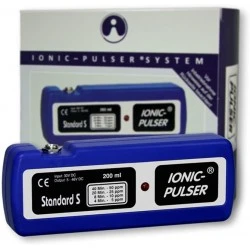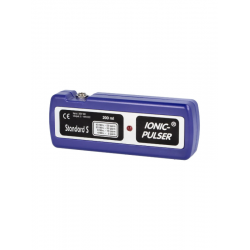
How long should an Ionic-Pulser run? Standard S and PRO 3 examples
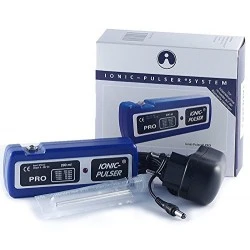
With an Ionic-Pulser, production time depends on the actual water volume, the desired nominal silver release, and the model and electrode connection. That is what the manufacturer's online calculator addresses: it returns separate times for Standard S and the A–B and A–C connections of PRO 3.
If you enter the wrong volume or read the time for the wrong connection, the calculation will not match your run. Here is how to use and interpret the results.

Start with two accurate inputs
- Water volume in ml: enter the amount actually in the glass. For 200 ml, enter 200—not the size of the water bottle or the beaker's nominal capacity.
- Desired silver release in mg/l: this is the target used for the manufacturer's timing calculation. Selecting 25 mg/l gives a time for that nominal release under the assumed conditions.
Then read the result for your model and actual electrode connection. Use the Standard S column for Standard S. On PRO 3, first establish whether the electrodes are connected at A–B or A–C. Do not copy the time from the neighbouring column.
Open the manufacturer's production-time calculator. A timing table is also included in the instructions for the corresponding generator.
A worked example: 200 ml and nominal release of 25 mg/l
| Model and connection | Time in the manufacturer's table | What this choice means |
|---|---|---|
| Ionic-Pulser Standard S | 20 minutes | The time for the basic model. |
| Ionic-Pulser PRO 3, A–B | 15 minutes | Closer electrode spacing; faster run. |
| Ionic-Pulser PRO 3, A–C | 18 minutes | Wider electrode spacing; slower than A–B. |
In this example, the 15-minute PRO 3 A–B time is 25% shorter than the 20-minute Standard S time. A–C takes longer than A–B; the manufacturer also associates the wider spacing with a reduced chance of conductive bridges forming between the electrodes.
For the same 200 ml but a selected 50 mg/l, the manufacturer's table lists 40 minutes for Standard S, 30 minutes for PRO 3 A–B and 33 minutes for PRO 3 A–C. The examples show why the correct column matters.
Why do A–B and A–C give different times?
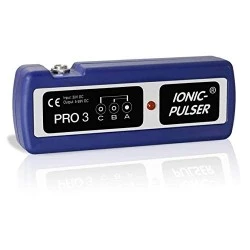
PRO 3 has a marked anode socket and two cathode connection options. Electrode spacing is shorter at A–B, so its tabulated run is faster. Spacing is wider at A–C, so the run takes longer. The manufacturer states that wider spacing helps prevent conductive bridges between electrodes.
If you own the EA Ionic-Pulser PRO 3, check the socket markings and follow its manual before starting. If you own the Standard S, the PRO 3 times do not apply to your model.
Calculated release is not a laboratory measurement
The manufacturer's table calculates silver released during electrolysis. Some silver may adhere to the glass or electrodes or be affected by other processes. The actual composition of the finished liquid may therefore differ from the number entered into the calculator. An ordinary TDS meter cannot reliably establish that difference.
For double-distilled water or water of very low conductivity, the manufacturer's instructions specify adding five minutes to the tabulated time. Apply this only under the conditions described in your model's manual. Do not add salt, mineral water or tap water to shorten a run.
Plan a run without guessing
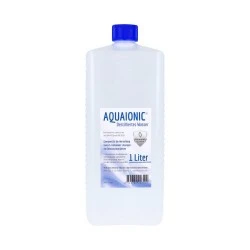
- Prepare a clean glass vessel and suitable distilled or demineralized water. EA offers Aquaionic 1 L for technical use.
- Measure the actual water volume. For small batches, EA offers a 250 ml graduated glass beaker. Its 250 ml marking is the vessel's capacity, not an automatic calculator input.
- Check the clean, compatible silver electrodes. EA replacement pair 39029 is intended for Ionic-Pulser; CM2000 electrodes are not its substitutes.
- Prepare the water and position the generator according to the manual, keeping the housing and sockets dry. Run it for the time corresponding to the correct model and connection.
- Disconnect the device at the end and clean the electrodes as instructed. For longer runs, the manual also describes checking and wiping the electrodes during the process.
For example, you pour 200 ml from a one-litre bottle. Enter 200 ml even if your beaker has a nominal 250 ml capacity. At a selected 25 mg/l, read 20, 15 or 18 minutes according to the model and connection. These are examples from the manufacturer's table, not universal times for every water source and process.
Frequently asked questions
Is “25 ppm” in the calculator a measured content of the finished liquid?
No. The calculator plans nominal silver release from time and water volume. Actual content may differ because of losses and other processes.
Why are the A–B and A–C times different?
Electrode spacing differs. Read the column for the connection you actually use.
Can I use the 200 ml time for 250 ml?
No. Enter the real quantity or consult the 250 ml row of the manual. A time for a different volume is the wrong choice.
Is a beaker included with the generator?
Check the contents of the specific EA offer. You may supply a suitable glass beaker or buy one separately from EA.
Before every run, check three details
Actual water volume, desired nominal release, and the correct model or connection column determine the manufacturer's calculated time. For 200 ml at 25 mg/l, its manuals list 20 minutes for Standard S, 15 minutes for PRO 3 A–B and 18 minutes for PRO 3 A–C. Use the calculator or your manual again for another volume.
This guide covers technical dispersion preparation. It offers no health recommendations and does not replace the instructions supplied with the device.