One Thermostat for Multiple IR Panels? When It Works and Why Two Rooms Need Separate Control
One wireless thermostat can control several IR panels when they all heat the same room or temperature zone. Across two separate rooms, one thermostat is normally unsuitable because it measures temperature in only one location.
First decide what counts as one heating zone
A heating zone is not defined only by walls or the number of panels. It is an area where you want approximately the same temperature at the same times and where one sensor can adequately represent the conditions across the space.
How do the IB1 and IB2 system actually work?

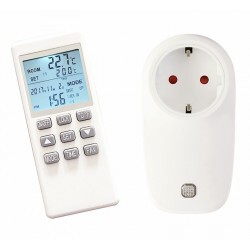
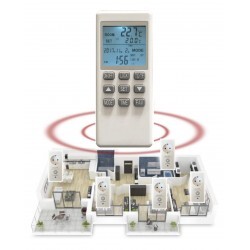
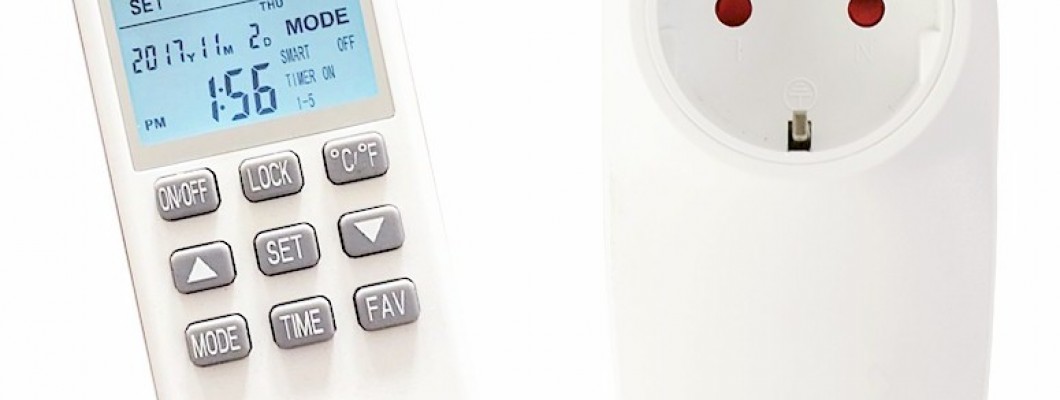
The IB1 controller measures the temperature where it is positioned. When the measured temperature falls below the set value, it sends a wireless command to its paired receivers. The receivers then switch the connected IR panels on.
One IB1 can be paired with up to 20 compatible receivers. This does not create 20 independent temperature zones. All paired receivers follow the same temperature sensor and the same control demand.
The additional IB2 is a switching receiver for the IB1 system. It does not measure temperature and does not independently decide when its panel should operate.
When is one IB1 with several receivers the right solution?
This arrangement is useful in a larger room where two or more IR panels are required for suitable heat distribution. Each panel is connected to its own compatible receiver and every receiver is paired with the same IB1 controller.
- All panels heat the same open room.
- One target temperature is suitable for the whole area.
- All panels should follow the same schedule.
- The thermostat can be placed in a representative location.
- The radio range has been tested at the intended positions.
Position the thermostat in the occupied area where you want the temperature measured. Do not place it directly beside a panel, in strong sunlight, above another heat source, next to frequently opened doors or in a noticeable draught.
Why does one thermostat cause problems across two rooms?
Imagine the IB1 is in the living room while a second receiver and panel are installed in a colder home office. When the living room reaches its target, the thermostat switches both panels off. The office may remain too cold because it has no sensor requesting additional heat.
Move the thermostat to the colder room and the reverse can happen: the living-room panel may continue running longer than necessary. The same issue applies to a bedroom, bathroom, guest room or office used according to a different schedule.
Quick control-system decision
| Situation | Recommended design | Reason |
|---|---|---|
| Two IR panels in one large living room | 1 × IB1 plus an additional IB2 | Both panels follow the same temperature and schedule. |
| Open-plan living and dining area | Possibly 1 × IB1 with multiple receivers | If the areas are thermally connected and use the same settings. |
| Living room and bedroom | A separate thermostat for each room | Different usage, schedules and target temperatures. |
| Office and meeting room | Two independent zones | The rooms may be occupied at different times. |
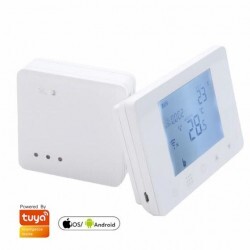
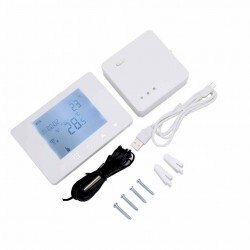
| Independent zone with app control | A separate IB6 for the relevant zone | Provides WiFi/Tuya control and its own weekly programme. |
Practical example: how separate zones can prevent unnecessary operation
Consider two separate rooms, each with a hypothetical 800 W panel. If both panels share one control demand and operate for four hours per day:
1.6 kW × 4 hours = 6.4 kWh per day.
If independent controls allow the first panel to operate for four hours and the second for only one and a half hours:
0.8 kW × 4 hours + 0.8 kW × 1.5 hours = 4.4 kWh per day.
The difference in this illustrative example is 2 kWh per day. At an assumed total electricity price of €0.25/kWh, this would equal €0.50 per day.
This is not a prediction of actual savings. Real consumption depends on insulation, outdoor conditions, room temperature, panel output, heat loss, tariffs and the thermostat's actual switching cycles.
Products for a correctly designed system

Infraboost IB1
Wireless room thermostat with LCD controller and plug-in receiver. It supports up to 20 compatible receivers. The receiver is rated for switching up to 3600 W or 16 A with a resistive load.
View the Infraboost IB1 thermostat
Infraboost IB2
An additional plug-in receiver intended for the IB1 system. Use it when another compatible IR panel must follow the same thermostat and heating zone.
View the additional IB2 receiver
Infraboost IB6
An option for an independent zone where WiFi/Tuya operation is required. The IB6 specifies a 10 A relay and a maximum resistive load of 2300 W. IB2 is intended for IB1 and must not be presented as an IB6 expansion receiver.
Checklist before connecting the system
- Calculate the required heating output for each room rather than using only the property's total floor area.
- Confirm that the panel can restart normally when its power supply is switched.
- Keep the connected panel within the receiver's permitted load.
- Connect one panel directly to one receiver; avoid unsuitable multiway adapters and chained extension leads.
- Test the radio range at the intended location. Thick walls, reinforced concrete and metal obstacles can reduce it.
- Check the electrical circuit capacity. The 3600 W figure applies to an individual receiver; it does not mean one household circuit can safely supply twenty such loads.
- For bathrooms, damp areas or fixed wiring, have suitability and installation checked by a qualified electrician.
Frequently asked questions
Can I pair one IB1 with 20 receivers in 20 rooms?
The system supports up to 20 compatible receivers, but all follow the same IB1 temperature sensor. Twenty rooms with different requirements would not become twenty independently regulated zones.
Does the IB2 measure temperature?
No. The IB2 is a wirelessly controlled switching unit. Temperature is measured by the IB1 controller.
Can I use an IB2 with an IB6 thermostat?
Do not assume this compatibility. The product information identifies IB2 as a receiver for IB1. Only use components explicitly specified as compatible with IB6.
Is the approximately 20-metre range guaranteed?
No. It is an approximate range through walls. Actual performance depends on building construction, wall thickness, metal obstacles and radio interference.
Is an open-plan kitchen and living room one zone?
It often can be when there are no doors, the areas are thermally connected and the same target temperature is wanted. In a long or irregular space with very different heat losses, check temperatures at several positions first.
Planning a system with several IR panels?
Before selecting a thermostat, note the number of rooms, each room's floor area and height, insulation quality, panel output and required heating schedule. This makes it possible to determine how many independent zones and receivers are actually required.
Telephone: +386 40 708 388
Email: narocila@eaelektronika.si
View Infraboost thermostats
Sources and product verification
- EA Elektronika – Infraboost IB1
- EA Elektronika – additional IB2 receiver
- EA Elektronika – Infraboost IB6
- Heatness – infrared-heating planning guide
- Heatness – individual room control
- Heatness – calculating output room by room
Sources and product links checked on 11 October 2026.