Menu
Your Cart

Radon – Risks, Measurements and Concentrations in Slovenia

Measure first. Then take action.

Measure radon and choose an effective solution to reduce its concentration in your home, basement or commercial premises.

1 MEASURE RADON Find out the radon concentration
2 REDUCE RADON Choose the appropriate solution

Choose the right path

Start by measuring the radon concentration. If the values are elevated, choose the appropriate solution to reduce them.

1
FIRST STEP

Measure radon

Check the actual radon concentration in the room and determine whether further action is needed.

  • Measurement in homes, basements or commercial premises
  • For a more representative result, measure at the same location for at least 1–2 months
2
SECOND STEP

Reduce radon

If the measurement shows an elevated concentration, choose a radon reduction method based on the building and the way radon enters it.

  • Room ventilation
  • Radon extraction from beneath the building
RADON IN SLOVENIA

Discover radon concentrations across Slovenia

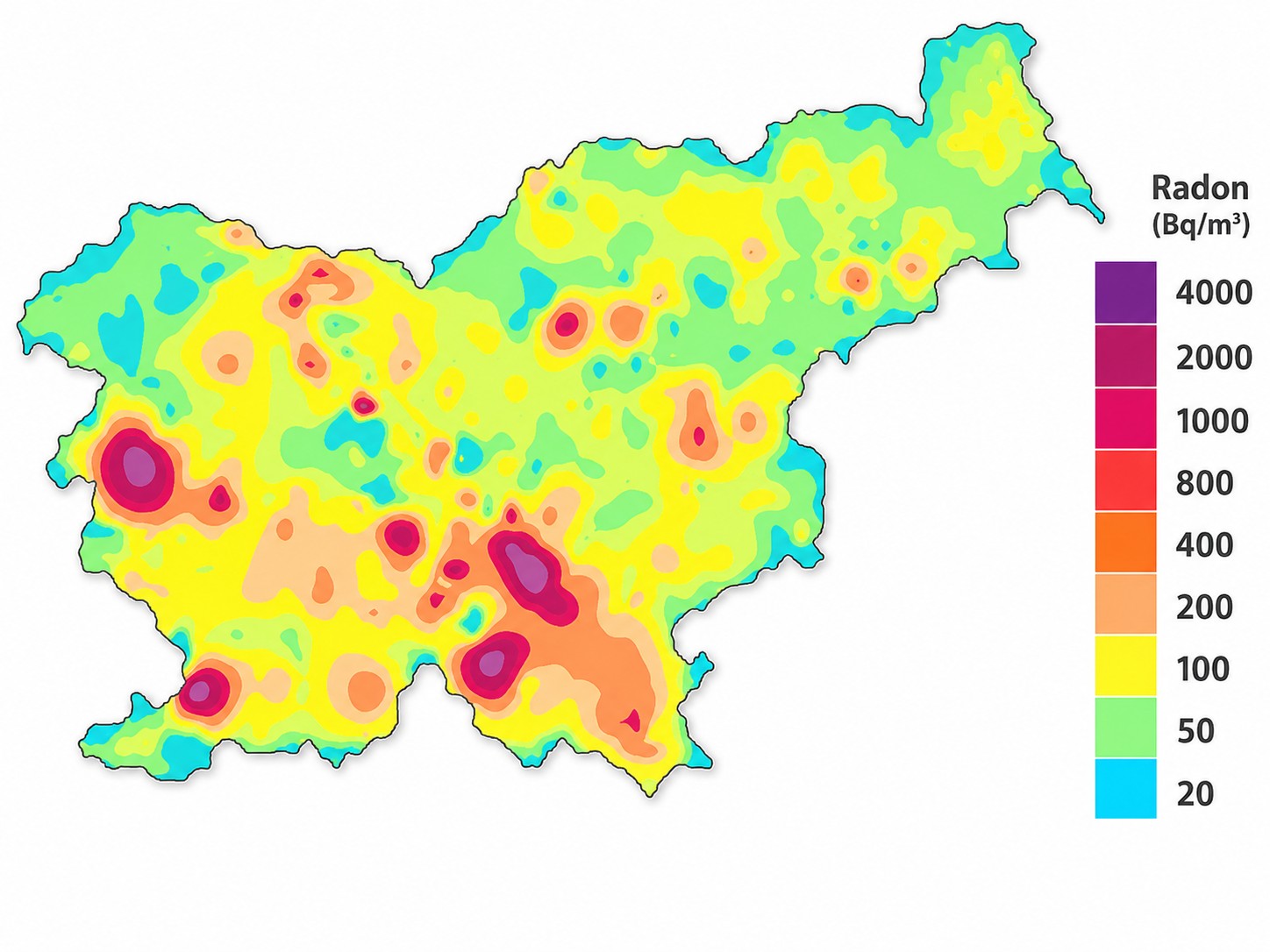
Radon concentrations vary significantly across Slovenia. The highest values are typically found in karst areas in the western and southern parts of the country. The actual concentration in your home can only be determined by measurement.

Radon concentration map Estimated radon concentration (Bq/m³)
Map of radon concentrations in Slovenia

The map shows geographical differences in the occurrence of radon. The actual concentration in an individual building cannot be determined from its location alone.

300 Bq/m³
EA Elektronika recommends keeping radon concentration below 100 Bq/m³.
Reference level in Slovenia Above this value, measures to reduce radon concentration should be considered.
Karst areas stand out The highest concentrations have been recorded mainly in western and southern Slovenia, where carbonate rocks predominate.
Location alone is not enough Radon concentration is also influenced by the ground beneath the building, its construction, foundation sealing, ventilation and the way the premises are used.
Measurement and continuous monitoring are essential Even in areas where lower radon concentrations are expected, an individual building may still show elevated values. Actual exposure is best assessed through measurement and continuous monitoring of radon concentration over a longer period.
Not sure what the radon levels are in your home or commercial premises? Measure radon and make decisions based on actual data.
VIEW RADON DETECTORS
FIRST STEP

Measure radon

Check the actual radon concentration in the room and determine whether further action is needed.

  • Measurement in homes, basements or commercial premises
  • For a more representative result, measure at the same location for at least 1–2 months
• Very easy to use
• Short-term and long-term averages
• Battery-powered
159.90 €
Ex Tax:131.07 €
Lowest price last 30 days: 159.90 €
FOR LONG-TERM MEASUREMENT

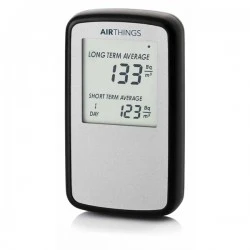
Airthings Corentium Home

A portable digital detector for easy, long-term monitoring of radon concentration in homes, basements, holiday properties or commercial premises.

What is it used for? For checking long-term radon exposure and comparing concentrations in different rooms.
No setup or programming required Nothing needs to be configured or programmed. Insert the batteries, place the detector in the room and wait for the first result.
Main benefit Works completely independently without an app, Wi-Fi connection or mains power supply.
Measurement range 0–9999 Bq/m³
Results Displays the first results after approximately 24 hours and shows 1-day, 7-day and long-term averages.
Accuracy over time Approximately ±10% after 7 days and approximately ±5% after 2 months at a concentration of 200 Bq/m³.
Power supply 3 × AAA batteries with an expected battery life of approximately 2 years.
Best suited for: users who want a simple, portable and independent detector for multi-week or multi-month radon monitoring without setup, apps or additional programming.
• First readings after just 1 hour
• OLED display
• monitoring app
199.00 €
Ex Tax:163.11 €
Lowest price last 30 days: 199.00 €
FOR FAST AND CONTINUOUS MONITORING

ECOSENSE RADON EYE RD200

A highly responsive digital detector for users who want to quickly check radon concentration and then continuously monitor how it changes over time.

What is it used for? For fast initial measurement, continuous radon monitoring and checking how the concentration changes over time.
First result after just 10 minutes RD200 provides a very fast first indication of radon concentration without waiting 24 hours for the first result.
Updates every 10 minutes Measurements are updated regularly, allowing you to quickly notice changes and fluctuations in indoor radon concentration.
Measurement range 7–3,700 Bq/m³
OLED display + Bluetooth app The current radon concentration is shown directly on the OLED display, while additional data can be monitored in the mobile app via Bluetooth connection.
Graphical view of radon fluctuations The app allows you to monitor short-term and long-term trends and view graphs showing how radon concentration changes over time.
Check the effect of ventilation and mitigation Thanks to fast measurements and graphical trend displays, you can observe how radon concentration changes during ventilation or after radon reduction measures have been implemented.
Power supply Continuous power via a 12 V DC adapter allows uninterrupted monitoring of radon concentration at the selected location.
Best suited for: users who want fast results, continuous monitoring and a clear graphical overview of short-term and long-term radon concentration fluctuations.
SECOND STEP

Reduce radon

If the measurement shows an elevated radon concentration, choose the appropriate method to reduce it based on the building and the way radon enters the room.

  • Ventilate the room and increase the air exchange rate
  • Actively extract radon from beneath the foundations or floor slab
• Automatic window opening
• Wi-Fi and OneSmart app
• 180 or 380mm chain stroke
229.90 €
Ex Tax:188.44 €
Lowest price last 30 days: 229.90 €
AUTOMATIC WINDOW VENTILATION

COMUNELLO SMART20 + AF-820 Wi-Fi

A motorised chain actuator for automatically opening and closing windows according to a schedule. It provides a simple way to ventilate rooms automatically, without having to open the windows manually several times a day.

What is it used for? For automatic room ventilation by opening and closing suitable windows at selected times during the day.
Automatic scheduled ventilation Using the OneSmart app, you can create schedules so the window opens and closes automatically at selected times.
Wi-Fi control The AF-820 control module connects the system to Wi-Fi and allows remote control and scheduled operation through the OneSmart app.
Different window opening types SMART20 can automatically operate suitable bottom-hung windows, including tilt-opening applications, as well as top-hung outward-opening windows, depending on the window construction and installation method.
No major construction work required Existing windows are used for ventilation, so in most cases there is no need for major construction work, additional ventilation openings or diamond drilling through external walls. Only suitable installation of the chain actuator and an electrical connection are required.
Ventilation can help lower indoor radon concentration Short periods of cross ventilation replace indoor air with outdoor air and can temporarily lower the radon concentration in the room. EA Elektronika recommends approximately 10–15 minutes of cross ventilation at a time.
EA Elektronika recommends 2 units For effective cross ventilation, we recommend using two actuators on suitable windows located on opposite sides of the room or building, whenever the layout allows it.
Window opening The chain stroke can be set to 180 mm or 380 mm, allowing the window to open automatically for room ventilation.
Basic technical data 230 V power supply, approximately 22 W power consumption during operation, 200 N pushing force and 250 N pulling force.
Safe and smooth operation Soft start and soft stop provide smooth movement, while integrated obstacle detection helps protect the actuator during operation.
Best suited for: homes, basements and other rooms where regular automatic ventilation can be used as part of a strategy for managing elevated indoor radon levels, especially where windows are not opened manually often enough.
• For extracting radon from beneath foundations
• Quiet and energy-efficient operation
• Suitable for indoor and outdoor installation
159.90 €
Ex Tax:131.07 €
Lowest price last 30 days: 159.90 €
CREATING NEGATIVE PRESSURE BENEATH THE BUILDING

RVB125 INLINE FAN 125 MM

A powerful inline fan with high airflow capacity that can be used as a component of a system designed to create negative pressure beneath the floor slab of a building. Such a system extracts air from the area beneath the building and discharges it outdoors, which can reduce the movement of radon-containing soil air into indoor spaces.

First measure radon across the lower floor Before any work is carried out, we recommend measuring radon in several rooms on the lowest occupied floor. This helps identify where radon concentrations are highest and provides a better picture of possible radon entry points into the building.
Choosing the extraction point The area with the highest measured values can be an important indicator when selecting a suitable location for the system. The final extraction point should also take into account the building structure, foundations, accessibility and conditions beneath the floor slab.
How does negative pressure work? The fan extracts air from beneath the building and creates negative pressure in a properly designed and well-sealed system. Soil air contaminated with radon is therefore directed toward the extraction point and discharged outdoors instead of moving toward the interior of the building.
High airflow for creating negative pressure The RVB125 provides airflow of up to approximately 490 m³/h and has sufficient capacity to create strong negative pressure in a properly designed duct system. The actual negative pressure achieved depends on the soil, building construction, system airtightness and resistance within the ductwork.
Access can be created from outside If the terrain, foundations and building structure allow it, an excavation can be made along the outside of the building to gain access to the area beneath the floor slab or alongside the foundation.
Excavation size depends on the building The external working excavation should only be as large as necessary to provide safe access and create the extraction point. The foundations must not be undermined or structurally compromised during the work.
Suction pit beneath the floor structure A small suction area is created at a suitable location beneath the floor structure, from which the fan extracts air. As a general guideline, approximately 20–50 litres of material may be removed, while the actual design depends on the building construction and permeability of the material beneath the building.
125 mm duct system The fan has a 125 mm connection. A suitable duct is installed from the extraction point to carry air from beneath the building to the outside.
Very good sealing is essential The point where the pipe passes through the building structure and all connections on the suction side must be thoroughly sealed. Air leaks reduce the negative pressure and can reduce the effectiveness of the entire system.
Discharge air outdoors Extracted air is discharged through the duct to a suitable location outside the building. The outlet should be positioned so that the discharged air cannot easily re-enter the building through windows, doors or other openings.
Continuous operation In an active system, the fan normally operates continuously because it maintains negative pressure in the area beneath the building while it is running.
Measure radon again after installation The effectiveness of the system cannot be reliably predicted from the fan capacity alone. After installation, radon concentration should be measured again and compared with the readings taken before the work.
Important: The RVB125 is a powerful 125 mm inline fan that can be used as a component of a system for creating negative pressure beneath a building. The effectiveness of such a system depends mainly on correct installation, building construction, permeability beneath the floor slab, system airtightness and the actual negative pressure achieved.
Manufacturer: Airthings Model: 39025
• Zelo enostavna uporaba
• Kratkoročno in dolgoročno povprečje
• Baterijsko napajanje..
159.90 €
Ex Tax:131.07 €
Lowest price last 30 days: 159.90 €
Manufacturer: Ecosense Model: RD200
• Prvi odčitki že po 1 uri
• OLED zaslon
• Aplikacija za spremljanje..
199.00 €
Ex Tax:163.11 €
Lowest price last 30 days: 199.00 €
Model: RVB125
• Za odvajanje radona izpod temeljev
• Tih in varčen pogon
• Primeren za zunanjo in notranjo montažo..
159.90 €
Ex Tax:131.07 €
Lowest price last 30 days: 159.90 €
Model: COMUSET2
• Samodejno odpiranje oken
• Wi-Fi in aplikacija OneSmart
• Hod verige 180 ali 380 mm..
229.90 €
Ex Tax:188.44 €
Lowest price last 30 days: 229.90 €
Showing 1 to 4 of 4 (1 Pages)
radon, radon measurement, radon detector, radon concentration, radioactive gas, radon risk, indoor air safety, Slovenia radon

Free delivery

For orders over €50 (SI) and €100 (HR).

Tel: +386 40 708 388

From 9:00 to 19:00, also via WhatsApp.

Delivery in 1–2 days (SI)

Orders placed by 12:00 are dispatched the same day.

Store pickup

By arrangement, also outside opening hours.