Radon in a school, kindergarten or office: room-by-room measurement and remediation checks
One detector in a corridor cannot tell you what children and employees breathe in a ground-floor playroom, classroom or office. A good plan connects the room inventory, preliminary monitoring, authorised measurement and verification of corrective work.
Why this is a real building-management issue
The Slovenian Radiation Protection Administration regularly examines kindergartens, schools, hospitals and other public buildings. Soil gas can enter through cracks, shafts, drains and service penetrations, so basements, ground floors and rooms directly above the ground deserve the first attention. A risk map is not a measurement of an individual building: neighbouring properties can produce very different results because of their foundations, sealing and ventilation.
A local report stated that a playroom in Idrija measured a little over 1,000 Bq/m³. After a sub-floor extraction system was installed, the reported average was 191 Bq/m³, with the fan required to run continuously.
The Municipality of Vransko reported that official post-remediation results for Vransko-Tabor Primary School and its kindergarten showed winter measurements below the reference or warning level and appropriate values during teaching hours.
These are specific cases, not an estimate of prevalence across all Slovenian schools and kindergartens.

Separate four different jobs
1. Preliminary screening
An active digital monitor quickly identifies rooms and time periods that need attention. It is useful for comparing rooms and observing the effect of occupancy schedules, airing and mechanical ventilation.
2. Official assessment
Decisions on mandatory measures, exposure assessment and formal records require the applicable protocol and an authorised provider. GOV.SI explicitly describes a simple meter as suitable only for preliminary assessment.
3. Remediation verification
After work is completed, compare the same room, the same measurement position and reasonably similar conditions. The result should be checked during actual occupancy, not only while windows are unusually left open.
4. Ongoing monitoring
A fan, damper, pipe or controller can fail. Long-term monitoring can reveal a gradual return of high concentrations and trigger maintenance before the problem remains hidden for months.
A room-by-room plan: from floor plan to measurement log
- Create a room inventory. Record the floor, ground contact, purpose, number of occupants, occupied hours, ventilation type and known service penetrations through the slab.
- Prioritise likely exposure. Start with occupied playrooms, classrooms, offices and sleeping rooms in basements or on the ground floor, especially those near cracks, shafts and services.
- Do not measure only the corridor. A corridor has a different air volume, door-opening pattern and ventilation. Its result may not represent a closed playroom or classroom.
- Choose a representative position. Place the monitor on a stable surface in the normal breathing zone, roughly more than 10 cm from a wall and away from direct sun, heaters, windows, doors and supply or extract grilles. Follow the instructions for the specific monitor.
- Keep a log. Record device ID, room, date and time, window opening, occupancy, unusual weather, ventilation service and every device move.
- Do not change conditions merely to improve the test. If the goal is actual exposure, operate the building normally. Run any special ventilation experiment separately and label it clearly.
Worked example: 8 ground-floor rooms and one fast monitor
Assumption: a kindergarten has six playrooms, a staff room and an office on the ground floor. One RADON EYE RD200 is available. The goal is not an official annual assessment, but a priority list for further measurement.
| Step | Time | Action | What the result means |
|---|---|---|---|
| Stabilisation | First hour | Leave the device in place; record the start and normal room conditions. | The RD200 displays its first result in under an hour, but this is not yet a representative average. |
| Screening | 48 h per room | Monitor each room over two working days and at least one night; eight rooms take about 16 days. | This provides a comparison and time pattern. It does not replace a measurement lasting at least three months. |
| Priority list | 1 day | Rank rooms by average, recurring high periods and occupancy. | Refer the highest and most heavily occupied rooms for authorised measurement. |
| Long-term measurement | ≥ 3 months | Keep the detector at an unchanged position; an authorised provider defines the correct protocol. | The result is much more suitable for estimating an annual average concentration. |
How can screening be shortened? Two devices can complete eight 48-hour room checks in about eight days. More devices do not shorten the required long-term measurement period; they only allow more rooms to be covered at the same time.
How to interpret readings without reaching the wrong conclusion
- 300 Bq/m³ is not a limit for one 10-minute reading. It is the reference level for annual average concentration in occupied indoor spaces.
- An overnight rise and a drop after airing are useful. They describe room dynamics, not long-term exposure by themselves.
- Examine occupied hours. A school needs to understand teaching hours, an office working hours, and a kindergarten the hours in which a playroom is used.
- A weekend is not a weekday. Closed windows and disabled ventilation may create a different pattern. The building log explains the graph.
- Summer can understate winter conditions. Longer airing and a weaker temperature-driven pressure difference often change radon entry. Official programmes therefore compare seasons when necessary.
- Do not calculate an official dose yourself. Dose also depends on occupancy time and other professional parameters; it should be assessed by an authorised provider.

After remediation: prove the effect and plan for failure
Remediation is not complete when a fan is switched on; it is complete when performance is measured. Preserve a baseline series before work, then measure at the same position under comparable conditions. If the system depends on a fan, name a responsible person, define an inspection interval, provide a way to detect failure and set a date for repeated measurement.
Example control record
“Playroom G-03, monitor on cabinet beside internal wall, 7 days before work, 7 days after work, same timetable. Fan operates continuously. Windows follow the normal airing protocol.”
Fan energy — worked assumption
At its stated maximum input of 65 W, 24-hour operation would use up to about 1.56 kWh/day or 569 kWh/year. At an assumed €0.20/kWh, that is about €0.31/day. Actual use and cost depend on the system, controller and tariff.
Which EA products support each step?
| Product | Verified features | Sensible role | Limitation |
|---|---|---|---|
| RADON EYE RD200 | First display < 1 h, 10-minute updates, OLED, Bluetooth LE, up to one year of hourly records, 12 V DC. | Fast room screening, time graphs and before/after comparisons for ventilation or mitigation. | A preliminary reading alone is not an official basis for mandatory action. |
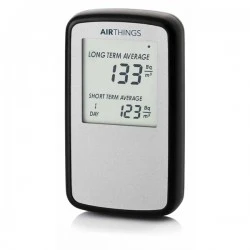
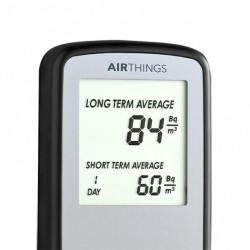
| Airthings Corentium Home, model 39025 | 0–9,999 Bq/m³, first result after about 24 h, 1-day, 7-day and long-term averages, 3× AAA. | Longer standalone monitoring of one room without mains power or an app. | An authorised provider must still confirm the protocol for an official assessment. |
| RVB125 inline fan | Ø 125 mm, up to 490 m³/h, 220/230 V AC, maximum 65 W, about 43 dB(A), IP44. | A component of a professionally designed system that depressurises and extracts soil gas beneath a building. | Not a standalone remedy or an ordinary room fan; performance must be verified by measurement after installation. |
Frequently asked questions
Can one monitor check an entire school?
You can move it systematically for preliminary comparison, but each series must be clearly labelled and long enough. Simultaneous long-term assessment of multiple rooms needs multiple devices or detectors and a protocol defined by an authorised provider.
Should a room be closed after one reading above 300 Bq/m³?
Do not make that decision from a short reading alone. Log the event, check ventilation and obtain professional advice promptly. Urgency is determined from representative measurements, exposure and applicable rules.
Is opening the windows enough?
Airing can reduce concentration temporarily, but the effect may disappear after the room is closed. Where soil gas is entering the building, a durable solution often requires a ventilation or construction measure selected after diagnosis.
Where should the monitor not be placed?
Not directly beside a window, door, radiator, air grille or direct sun; not inside a closed cabinet; and not where occupants regularly move it. Always follow the instructions for the actual device.
How do we know remediation still works?
Combine periodic system inspection, failure indication and repeated measurements in the same room. The Idrija example matters precisely because the result was measured after remediation and the fan must continue to operate.
From floor plan to verified result
Start with an inventory of basement and ground-floor rooms, perform documented preliminary screening, and then involve an authorised provider for the official assessment. If corrective work is required, always verify its effect by measurement during real occupancy.
Explore EA Elektronika radon monitors and mitigation equipment →
Sources and verification date
- Slovenian Radiation Protection Administration: Reducing exposure to radon — reference level, monitoring programme, authorised providers and the limitation of preliminary meters.
- NIJZ: Basic information on radon — annual average, minimum three-month measurement and Slovenian risk areas.
- Municipality of Vransko / MojaObčina, 2026 — official post-remediation results for the school and kindergarten.
- Idrija.com, 13 Jan 2025 — report on measurement and remediation at Prelovčeva kindergarten.
- EA: RD200, EA: Corentium Home and EA: RVB125 — verified product features.
Sources and links checked on 4 October 2026. This article is informational and does not replace an official measurement, an authorised provider's report or a professional mitigation design.