V15 – Remote Copying and Compatibility With European Garage Doors
Do you have a Hörmann garage door, a NICE or BFT driveway gate, and several different remotes? Perhaps you need an extra transmitter for a family member or a replacement for an older original that is difficult to find.
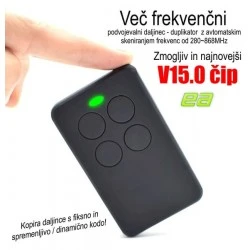
The V15 universal remote duplicator can store up to four compatible radio signals on four independent buttons. It supports selected transmitters within its advertised 280–868 MHz frequency range, including certain fixed-code and rolling-code systems.
However, not every 433 MHz or 868 MHz remote is compatible. Particularly important are the differences between older Hörmann systems and modern BiSecur, between SOMMER radio generations, and between the various protocols used by NICE, CAME, FAAC and BFT.
This guide provides step-by-step V15 programming, specific European remote model references, compatibility limitations and practical troubleshooting advice.
1. What can you do with the V15?
Four devices, one remote
Different compatible signals can be assigned to individual buttons, such as garage doors, driveway gates, parking barriers or other supported radio receivers.
Multi-frequency operation
The V15 automatically scans for supported radio signals within its advertised 280–868 MHz range. This does not guarantee support for every protocol operating in that range.
Fixed and rolling codes
Compatible fixed-code remotes can usually be copied directly. Certain rolling-code systems require a seed code and registration with the receiver.
Simple daily operation
Once programmed, use the assigned button as you would on a normal remote. The V15 operates with a CR2032 coin cell and does not require a smartphone or app.
Frequency versus protocol: two remotes can both transmit around 868 MHz while using completely different coding methods. The V15's broad frequency range alone does not establish compatibility.
2. Check your original remote before copying
- Find its model number. Check the back, battery compartment or gate opener documentation.
- Identify its frequency. Common frequencies include 433.92 MHz and 868 MHz, while other systems operate on different bands.
- Determine the coding method. Fixed-code and rolling-code remotes require different procedures.
- Check registration permissions. In shared apartment garages, only an authorized person may be allowed to add a transmitter.
- Test the original remote. Copying may fail if the original is faulty or has a depleted battery.
If you have the remote but do not know its model, photograph the front, rear and any label inside the battery compartment. These details are more useful than the brand name alone.
3. How to program the V15 – fixed code
For compatible fixed-code remotes, the V15 can usually learn the signal directly from the original transmitter.
Press and hold button 1 on the V15. While holding it, press button 2 four times, then release both buttons.
In the documented V15.0 procedure, the LED flashes briefly approximately every two seconds. Other production versions may show a slightly different timing pattern.
Place the original remote in front of the V15. Start at approximately 4–5 cm and adjust the position if necessary. V15.0 documentation specifies a distance range of approximately 4–60 cm.
Hold the button on the original remote that you want to copy until the V15 LED begins flashing faster.
While the LED is flashing rapidly, press and hold the chosen V15 button until the LED goes out.
Test operation on your own gate or another system you are authorized to control. Keep people and obstacles clear of the moving door.
Repeat the procedure for another signal, selecting a different V15 button when saving.
Important: entering learning mode is not necessarily the same as clearing the memory. Do not erase all stored buttons before every programming attempt without checking the instructions for your particular unit.
4. Rolling code – why copying alone may not work
Rolling-code systems change their transmitted code during normal use. As a result, a receiver may reject a new transmitter even if the V15 has successfully received a transmission from the original.
- Enter V15 copying mode by holding button 1 and pressing button 2 four times.
- Transmit the selected signal from the original remote.
- For certain supported protocols, the V15 enters a state where it waits for a seed code.
- Transmit the seed code using the procedure specified for the exact original remote.
- When the V15 confirms reception, save the signal to the chosen button.
- If required, register the new transmitter with the receiver.
Some BFT MITTO versions use a hidden button or a special combination to transmit the seed code. Certain FAAC SLH and GENIUS systems require a compatible MASTER transmitter. Selected V2 systems use an additional transmission of the same original button.
Not every rolling-code system can be duplicated. Some security protocols are specifically designed to prevent conventional cloning.
5. Does the V15 work with Hörmann garage doors?
It may work with certain older systems, but not by ordinary copying of modern BiSecur codes.
Hörmann has used several radio generations over the years. This is an important example of why a simple 868 MHz frequency label is not enough to identify compatibility.
Older Hörmann – 868.3 MHz fixed code
Many older Hörmann remotes feature a grey housing with blue physical buttons. Examples include HS1/HS2/HS4-868, HSM2/HSM4-868 and HSE2-868.
Compatibility with this older radio family is declared for certain multi-frequency replacement remotes, including the V15. The exact model number and coding system should still be verified.
Physical button colours can help identify older versions, but there are exceptions. Some earlier 868 MHz transmitters have different shapes or button colours. Always check the model number as well.
Modern Hörmann – BiSecur (BS)
Hörmann BiSecur uses a protected radio protocol with 128-bit encryption. Common transmitter designations include HSE 2 BS, HSE 4 BS, HS 4 BS and HS 5 BS, as well as other models with BS or 868-BS in their name.
The V15 is not verified for ordinary duplication of BiSecur codes. Although BiSecur also operates in the 868 MHz band, its radio protocol is not the same as the older fixed-code system.
| Hörmann system | V15 compatibility | Explanation |
|---|---|---|
| HSM4-868, HSM2-868, older blue-button models | Possible – declared support | Older 868.3 MHz fixed-code family; exact model must be checked. |
| HS1/HS2/HS4-868, HSE2-868 | Possible – verify version | Older 868 MHz system without the BS designation. |
| HSE 2 BS, HSE 4 BS, HS 4/5 BS | No ordinary BiSecur cloning | Protected BiSecur radio protocol. |
| Older 40.685 MHz or 26.975 MHz systems | No | Frequencies outside the V15's advertised operating range. |
How can you tell the difference?
On many older Hörmann transmitters, blue physical buttons are associated with the 868 MHz fixed-code family. With BiSecur, the BS model designation is especially important; certain remotes display a blue LED while transmitting a BiSecur code.
Some original BiSecur remotes can be switched into an older 868 MHz fixed-code mode for use with compatible legacy receivers. This is a special feature of the original Hörmann transmitter. Switching modes does not make the V15 compatible with a receiver that requires BiSecur.
Practical example: if you have an older Hörmann installation and an HSM4-868 remote with blue physical buttons, the V15 is worth investigating as a possible replacement. If your newer garage uses an HSE 4 BS with a BiSecur receiver, select an original or explicitly verified BiSecur-compatible transmitter instead.
Further reading: official Hörmann BiSecur documentation.
6. V15 compatibility with other popular European gate brands
The following table describes supplier-declared compatibility for selected remote-control families. It is not a record of individual physical tests covering every V15 version, receiver and firmware combination.
| Manufacturer | Listed models or families | What buyers need to know |
|---|---|---|
| NICE | FLO1/FLO2/FLO4, FloR FLO1R/FLO2R/FLO4R, INTI, ONE, SMILO | Different protocols including FLO, FloR, O-Code and Smilo. Some require receiver registration. |
| CAME | TOP 432 NA, TOP 432 EV, TOP 434 EV, TAM 432 SA | Check TOP/TAM encoding mode and exact transmitter version. |
| BFT | MITTO 2/4, MITTO B RCB, KLEIO, GHIBLI | Certain rolling-code versions need a seed code and receiver registration. |
| FAAC | XT2/XT4 433 SLH, XT2/XT4 868 SLH, older TM DS | SLH procedures may require a compatible MASTER; newer FDS is not equivalent to SLH. |
| BENINCÀ | TO.GO2WV/4WV, T2WV/T4WV and selected older versions | Check HCS versus ARC coding. Modern ARC is not automatically compatible. |
| SOMMER | Selected older 434 and 868 MHz systems | Modern SOMloq2, including TX55-868, is not verified as supported. |
| MARANTEC | Selected older 433.92 and 868.3 MHz remotes | Do not confuse them with modern encrypted bi·linked. |
| NOVOFERM | NOVOTRON 502, NOVOTRON 504 | Declared compatibility; verify exact transmitter and receiver versions. |
| DITEC | GOL4, BIXLP2 | Compatibility depends on the individual radio protocol. |
| MHOUSE | TX4, GTX4 | Certain receivers may require additional activation. |
For other familiar European-market brands such as Somfy, Chamberlain/LiftMaster and Wiśniowski, generic brand lists are insufficient evidence of compatibility with an individual remote. Do not purchase on brand name alone without confirmation of the exact model.
7. SOMMER: why 868 MHz does not guarantee compatibility
SOMMER uses several generations of radio technology. The older Somloq Rollingcode system operates around 868.8 MHz, while the newer SOMloq2 uses a modern protected protocol, including operation at 868.95 MHz.
SOMMER identifies TX03-868 as an example of its older generation and TX55-868 as an example of SOMloq2. These are distinct radio systems even though their frequencies are close.
Some older SOMMER systems are generally listed as supported by V15-compatible multi-frequency technology, but TX55-868 and SOMloq2 are not verified as compatible. This is especially important for newer SOMMER base+ operators and related installations.
Practical advice: always read the precise SOMMER remote model number before ordering. A frequency around 868 MHz is not sufficient evidence that the V15 will work.
8. NICE and CAME – important differences
NICE: FLO is not the same as FloR, O-Code or Smilo
NICE has developed several different radio families. Models listed for the V15 include selected older FLO transmitters, FloR, certain ONE/INTI models and SMILO.
However, official NICE documentation explains that some receivers support multiple coding families while requiring the registered transmitters to belong to compatible protocol families.
Example: a fixed-code NICE FLO2 and a rolling-code NICE FLO2R-S are not the same technology. The former may only require direct duplication; the latter may need receiver registration.
CAME: check TOP and TAM modes
Selected older CAME TOP and TAM remote families are included in compatibility listings. Official CAME documentation distinguishes between TOP and TAM operating modes with different code lengths.
If the V15 cannot learn the signal even when both transmitters operate at 433.92 MHz, verify the exact transmitter model and its configured encoding mode. Similar-looking housings do not guarantee identical protocols.
Sources: NICE – OXI receivers and coding families and CAME – TOP 433.92 MHz.
9. BFT, FAAC and Benincà – rolling-code differences
BFT MITTO
With selected BFT MITTO remotes, the V15 copying process may request a seed code. Some original models transmit this through a hidden button; others use a special button combination.
After saving the code, registration with the receiver may still be necessary. If the installation does not permit adding remotes without access to the control unit, copying alone will not be sufficient.
FAAC SLH and GENIUS
For selected older FAAC SLH and GENIUS models, the documented procedure requires a suitable original MASTER transmitter.
On certain versions, the MASTER's LED flashes briefly before staying lit, while a SLAVE's LED illuminates immediately. The seed code must then be transmitted according to the original model's instructions.
Do not assume that newer FAAC FDS transmitters are compatible with the older SLH programming procedure.
Benincà HCS versus ARC
Benincà uses older HCS rolling-code technology as well as its newer ARC – Advanced Rolling Code system.
The manufacturer provides coding-mode selection on certain original transmitters. However, this does not prove that the V15 supports every ARC model. Check the exact remote model and the operating mode before ordering.
10. Marantec, Novoferm and other European systems
Selected older Marantec 433.92 and 868.3 MHz remotes are listed as potentially compatible with multi-frequency replacement transmitters.
By contrast, newer Marantec bi·linked technology uses 128-bit AES encryption and changing radio codes. Conventional V15 cloning is not verified for this protected system.
For Novoferm, NOVOTRON 502 and NOVOTRON 504 appear in compatibility listings, although the exact transmitter and receiver versions still need to be checked.
The same caution applies to parking barriers, shared garages and industrial doors. One operator brand does not necessarily imply one radio protocol.
11. The V15 learns a signal, but the door does not open
| Problem | Possible cause | Next action |
|---|---|---|
| V15 does not enter copying mode | Battery or incorrect button sequence | Check CR2032 and the supplied instructions. |
| Original works, but V15 cannot learn it | Distance, position or unsupported protocol | Change positioning and verify the original model. |
| LED confirms copying, but the door does not open | Rolling-code registration required or protocol unsupported | Check receiver compatibility and the official procedure. |
| Hörmann BiSecur fails | Protected BS protocol | Use an explicitly compatible BiSecur transmitter. |
| SOMMER TX55 fails | Modern SOMloq2 protocol | Choose a suitable SOMloq2 transmitter. |
| FAAC copying stops | Original is not a compatible MASTER | Verify the remote generation and original transmitter status. |
| NICE receiver does not respond | Different coding family or registration required | Check FLO/FloR/O-Code/Smilo and receiver configuration. |
For shared garages, the building manager may control transmitter registration. Use only the approved registration procedure and do not attempt to bypass receiver security restrictions.
12. Three practical purchasing examples
An older Hörmann garage
The original HSM4-868 has blue physical buttons and uses the older 868.3 MHz system. The V15 is a possible candidate if the exact protocol matches and you have a working original remote.
A modern Hörmann BiSecur garage
The original HSE 4 BS uses protected radio technology. The V15 is not recommended for direct BiSecur cloning. Choose an explicitly compatible transmitter instead.
BFT and NICE driveway gates
If both original remotes belong to supported families, one signal can be stored on V15 button 1 and the other on button 2. Complete any required rolling-code registration first.
A newer SOMMER installation with TX55
TX55 identifies the modern SOMloq2 radio generation. Before buying, select an explicitly compatible transmitter instead of relying on the 868 MHz frequency label.
13. Frequently asked questions
Can the V15 copy every Hörmann remote?
No. Compatibility is declared for certain older 868.3 MHz fixed-code transmitters, while ordinary copying of modern BiSecur is not supported.
Do blue Hörmann buttons guarantee compatibility?
They are a useful clue on selected older models, but not definitive proof. Check the model number and frequency, because exceptions exist.
Can the V15 copy a NICE FloR remote?
Selected FloR models are listed as compatible, but receiver registration may be required. Verify the exact original model first.
Can it copy SOMMER SOMloq2?
Compatibility is not verified. Do not purchase the V15 specifically to copy TX55-868 or other modern SOMloq2 remotes.
Does the V15 support BFT MITTO?
Selected versions are listed as supported, although copying may require a seed code and additional receiver activation.
Can the four buttons store different brands?
Yes, if all their signals are compatible. Each button can be assigned a different supported radio signal.
Must I erase memory before every copy?
Do not assume so. Follow the instructions for the particular firmware version; an incorrect reset may erase previously stored buttons.
Does the V15 replace every function of the original remote?
Not necessarily. Special features such as bidirectional communication, door-position feedback and additional security functions may not be available.
V15 – a convenient solution for compatible garage and gate systems
If you use older compatible transmitters or several different supported radio systems, the V15 can simplify everyday operation. Instead of carrying multiple remotes, you may be able to use one compact four-channel transmitter.
Before ordering, check the original model, frequency and encoding system. For Hörmann BiSecur, SOMMER SOMloq2 and other protected radio technologies, choose an explicitly verified compatible solution.
Explore the V15 Universal RemoteConclusion and technical references
The V15 can be a convenient replacement for many older and selected modern radio transmitters. However, compatibility depends on more than frequency. Successful programming requires the correct protocol and, for certain rolling-code systems, additional receiver registration.
Compatibility information is based on supplier declarations and official technical information about the relevant radio systems. It does not represent physical testing of every V15 and receiver combination.