XTAR VX4 or L4? Choosing a Charger and 1.5V Li-ion Batteries
Do you regularly replace batteries in remote controls, game controllers, wireless mice, flashlights or other household devices? If so, you may have wondered whether it makes more sense to keep buying disposable alkaline batteries or switch to rechargeables.
There is one important distinction. Most conventional rechargeable AA and AAA batteries use NiMH chemistry with a nominal voltage of 1.2V. Modern XTAR 1.5V rechargeable Li-ion batteries include built-in electronics that regulate their output voltage.
XTAR also offers two useful chargers: the XTAR L4 for straightforward AA and AAA charging, and the XTAR VX4 Visible Mixer for users who also want to charge other battery formats and assess battery capacity.
This guide uses practical examples to explain which charger suits different needs, which batteries each model supports, and why a higher mAh rating does not automatically make one battery the better choice.
1. Why does the difference between 1.2V and 1.5V matter?
A conventional alkaline AA battery has a nominal voltage of approximately 1.5V. Its voltage gradually decreases during discharge. A rechargeable NiMH battery has a nominal voltage of 1.2V, but that does not make it inferior or unsuitable for everyday use.
Many devices are designed to work correctly with NiMH batteries. Some devices, however, are more sensitive to lower voltage or use relatively simple battery-level detection.
1.2V NiMH
PROVEN EVERYDAY CHOICESuitable for many remote controls, toys, lights and other electronics. Advantages include wide availability, established technology and compatibility with numerous standard NiMH chargers.
XTAR 1.5V Li-ion
REGULATED VOLTAGEIntegrated electronics maintain an approximately constant 1.5V output through much of the discharge cycle. This may help devices affected by voltage drop or premature low-battery warnings.
Example: a device uses four AA batteries connected in series. Four alkaline batteries have a combined nominal voltage of 6V, while four NiMH batteries provide 4.8V nominally. Devices designed for both operate without difficulty, but voltage-sensitive devices may behave differently.
Regulated Li-ion batteries also have a limitation. Battery-level indicators may behave differently from those used with alkaline cells. Some regulated batteries maintain approximately 1.5V until near depletion, followed by a relatively sudden output cutoff. Special versions with a modified discharge curve, such as the XTAR CLR 4300, attempt to improve low-battery indication, but actual behaviour depends on the device.
2. XTAR L4 – straightforward everyday charging
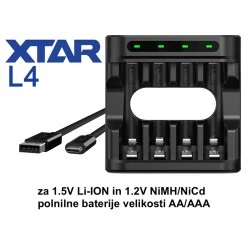
The XTAR L4 is designed primarily for users who need to charge standard AA and AAA batteries.
Its main advantage is the ability to use one charger for both 1.5V rechargeable Li-ion and 1.2V NiMH AA/AAA cells. The charger automatically identifies supported batteries and adjusts the charging method.
- Four independent channels: charge one, two, three or four cells.
- AA and AAA sizes: supports the most common household battery formats.
- USB-C power: uses a 5V input, with 5V / 2A recommended.
- Charging current: up to 0.5A per channel, according to XTAR.
- Automatic identification: distinguishes compatible 1.5V Li-ion and NiMH cells.
- LED indicators: monitor each charging slot without needing a complex LCD.
How do you use the XTAR L4?
- Connect the supplied USB-C cable to a suitable 5V USB power adapter.
- Insert compatible AA or AAA rechargeable batteries, observing polarity.
- The charger identifies the supported battery type and starts charging.
- A steady red LED indicates normal charging; steady green indicates completion.
- A rapidly flashing red LED may indicate an incorrect, damaged or unsupported battery. Do not attempt to force charging.
What can the XTAR L4 not charge? It is not intended for conventional 3.6/3.7V Li-ion cells such as 18650, 21700 or 14500, nor for 3.2V LiFePO4 cells. It also lacks the capacity-testing function found in the XTAR VX4.
XTAR states an approximate charging time of 2.9 hours for four of its 4150mWh AA Li-ion cells under specified test conditions. Actual times depend on battery type, power supply and state of charge.
Who should choose it? Users who want a simple AA/AAA charger without advanced diagnostic features.
3. XTAR VX4 – a charger that can also measure capacity
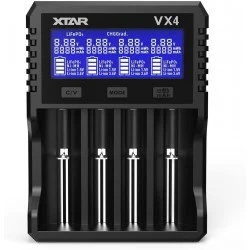
The XTAR VX4 Visible Mixer is designed for users who own several different kinds of rechargeable batteries.
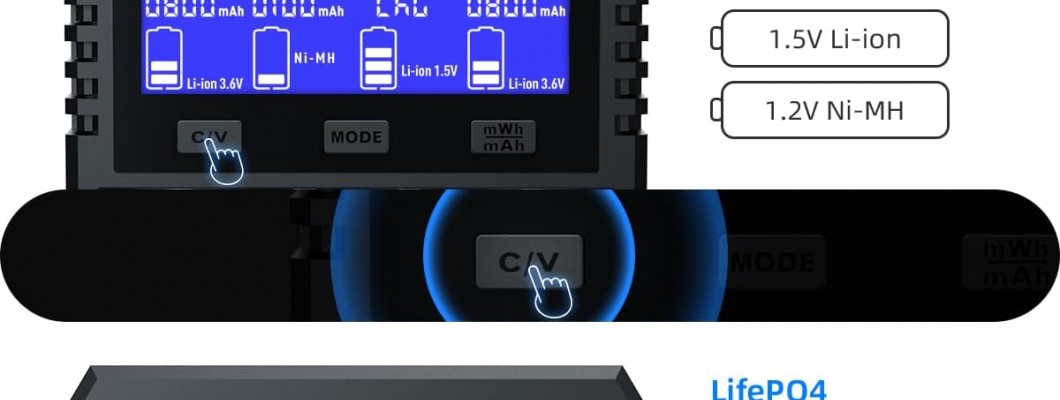
In addition to 1.5V Li-ion and 1.2V NiMH batteries, it supports 3.6/3.7V Li-ion cells, including common 18650 and 21700 formats, and 3.2V LiFePO4.
Four independent slots
Supports different compatible sizes within its four charging slots. Chemistry-mixing restrictions and the instructions for the selected charging mode must be followed.
Large LCD display
Shows charging information such as current, status and slot-specific data. Available readings depend on battery chemistry and the selected operating mode.
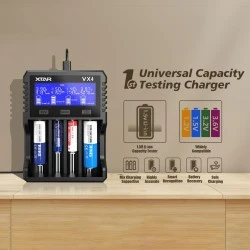
GRADE capacity testing
Performs a controlled charge, discharge and recharge process to estimate the usable energy or capacity of supported rechargeable batteries.
Power adapter included
EA lists a 20W PD power adapter and USB cable with the VX4SET package. Charging current depends on available input power and battery condition.
Compatible lithium cells may be charged at currents of up to 3A under suitable conditions, but this does not apply to all batteries or all slots simultaneously. XTAR specifies a fixed 0.5A charging current for 1.2V NiMH batteries. Higher charging current is not automatically better.
How to start a normal charging session
- Connect the charger to a suitable USB-C power supply; use the included PD adapter for the EA VX4SET package.
- Check the battery's rated voltage and chemistry on its label.
- Use standard mode for compatible 1.5V Li-ion, 1.2V NiMH and 3.6/3.7V Li-ion batteries.
- For 3.2V LiFePO4 batteries, select the dedicated LiFePO4 mode according to the instructions before charging.
- Insert the battery, check the detected chemistry and choose an appropriate permitted charging current when required.
- When charging is complete, remove the batteries and disconnect the power supply.
Important: do not simultaneously charge 3.2V LiFePO4 and 3.6/3.7V Li-ion batteries under one mode. An incorrect mode may damage the cell. Similar physical dimensions do not imply electrical compatibility.
4. The key difference: what does capacity testing tell you?
Normal charging tells you that a battery has accepted a charge. It does not necessarily tell you how much usable energy the battery can deliver afterward.
The XTAR VX4 provides a GRADE mode that performs a controlled charge, discharge and recharge cycle. The result can help you compare batteries and identify cells with significantly reduced usable capacity.
A practical example
Imagine owning four identical rechargeable batteries for a flashlight. One appears to run out considerably faster than the others.
Instead of guessing, you can use GRADE with supported batteries. If three cells deliver similar energy under comparable test conditions while the fourth performs substantially worse, there is a good reason to investigate further or replace it.
This is not a laboratory analysis of every battery characteristic. Results depend on discharge current, temperature, age, protection electronics and the chosen testing procedure.
Why is mWh useful for 1.5V Li-ion batteries?
mAh describes electrical charge, while mWh describes energy. When comparing batteries of different nominal voltages, the energy rating in mWh is often more informative.
| Hypothetical battery | Nominal voltage | Capacity | Simplified energy |
|---|---|---|---|
| NiMH AA | 1.2V | 2500mAh | Approximately 3000mWh |
| Regulated Li-ion AA | 1.5V | 2000mAh | Approximately 3000mWh |
In this simplified example, both batteries have similar nominal energy despite different mAh ratings. Actual delivered energy depends on discharge conditions and battery electronics; this is not a measured comparison of two commercial products.
XTAR's regulated 1.5V Li-ion batteries also have voltage-conversion losses. This is one reason measured output energy is informative, although results from different chargers and test methods may not be directly comparable.
GRADE compatibility: XTAR has released both VX4 and VX4 V2. The manufacturer lists wider 1.5V Li-ion battery compatibility for V2. Since EA's current product description also mentions capacity-testing limitations for certain 2700mAh and 3000mAh AA batteries, verify the exact charger version and documentation before buying specifically to test these cells. Charging compatibility does not automatically guarantee GRADE compatibility.
5. XTAR VX4 vs XTAR L4: feature comparison
| Feature | XTAR L4 | XTAR VX4 |
|---|---|---|
| Charging slots | 4 | 4 |
| 1.5V Li-ion AA/AAA | Yes | Yes, depending on version |
| 1.2V NiMH AA/AAA | Yes | Yes |
| 3.6/3.7V Li-ion 18650/21700 | No | Yes |
| 3.2V LiFePO4 | No | Yes, with proper mode |
| Larger NiMH C/D sizes | No | Yes, supported formats |
| GRADE capacity testing | No | Yes, supported batteries |
| Display | LED | LCD |
| Power input | USB-C, 5V | USB-C, PD/QC |
| Adapter included in EA offer | No USB power adapter | 20W PD with VX4SET |
| Best suited to | Everyday AA/AAA charging | Multiple formats and battery analysis |
In short: if you only charge AA and AAA batteries, the XTAR L4 is the more straightforward option. If you also use 18650 or 21700 Li-ion cells, or want to test battery capacity, the XTAR VX4 offers considerably more flexibility.
6. Which XTAR 1.5V Li-ion batteries should you choose?
EA Elektronika offers several models with different sizes, capacities and discharge characteristics. Always start with the physical size required by your device, then check current requirements and electrical compatibility.
XTAR R6 AA – 2000mAh
MODEL 83020A rechargeable AA battery with a regulated 1.5V output and integrated protection electronics. Designed for compatible everyday devices where users want a rechargeable alternative to disposable batteries.
XTAR R03 AAA – 1000mAh / 1620mWh
MODEL 83035A smaller AAA-format rechargeable battery for compatible remote controls, electronics, flashlights and other AAA-powered devices. Requires a charger specifically supporting 1.5V Li-ion batteries.
XTAR CLR 4300 AA – 4300mWh
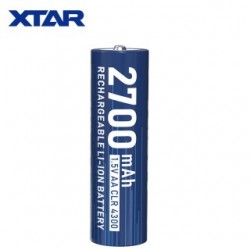
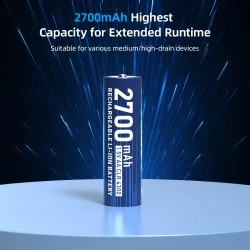
MODEL 83036A high-energy AA battery rated at 2700mAh / 4300mWh. Its discharge-curve design aims to provide more informative low-battery behaviour in compatible devices. Potential applications include some trail cameras and higher-demand AA devices.
Important: XTAR 14500 is not a standard AA!
3.7V IS NOT 1.5VA 14500 cell is physically similar in size to an AA battery, but normally has a nominal voltage of 3.6/3.7V. Never insert it into an ordinary 1.5V AA-powered device unless the device manufacturer explicitly supports that chemistry.
For devices used infrequently, also consider kit cost, self-discharge, consumption by the internal regulation circuit and low-battery indication. Li-ion is not automatically the best option for every remote control or clock.
7. Where can 1.5V Li-ion batteries be especially useful?
Trail cameras and outdoor electronics
Some trail cameras are sensitive to supply voltage, particularly during periods of higher current demand. Regulated AA batteries may therefore be an attractive option. Check the equipment manufacturer's battery recommendations, maximum current, temperature range and battery-level detection method before use.
Electronic toys and game controllers
Stable output voltage can help some higher-consumption devices perform consistently. However, do not use 1.5V Li-ion cells in equipment with its own battery charging system unless that specific chemistry is approved by the manufacturer.
Measuring instruments and portable electronics
Some voltage-sensitive devices may benefit from a regulated output. Always check approved battery types for measuring and safety-critical equipment; a battery fitting into the compartment does not establish electrical compatibility.
Remote controls and wall clocks
For very low-power devices, quality NiMH or alkaline batteries may already be entirely adequate. The advantages of regulated lithium cells may not justify their higher initial cost.
8. What about cost and long-term savings?
Rechargeable batteries require a higher initial investment but can be reused. The actual economics depend on battery and charger prices, the number of usable charging cycles, electricity consumption and how often disposable batteries would otherwise need replacing.
XTAR specifies hundreds or more than a thousand cycles for certain battery models. Such figures are based on defined test conditions and are not a guarantee that every cell will achieve the stated number of cycles in every application.
If you replace batteries every week, switching to rechargeables may recover the initial cost much sooner than in a device where alkaline cells already last for years.
Practical tip: for frequently used devices, buy enough matching rechargeable batteries to keep a spare set ready while the other set charges. Within a single device, use properly matched cells of the same chemistry and comparable state of charge.
9. Seven important charging safety rules
- Check voltage and chemistry: 1.5V Li-ion, 1.2V NiMH, 3.7V Li-ion and 3.2V LiFePO4 are different battery types.
- Never recharge ordinary disposable alkaline batteries. An AA or AAA size label does not mean that the cell is rechargeable.
- Use an explicitly compatible charger for 1.5V Li-ion. A conventional NiMH charger is not automatically suitable.
- Do not charge damaged cells. Remove batteries showing deformation, damaged insulation, leakage or abnormal heating from use.
- Charge on a dry, non-flammable surface and never cover the charger during operation.
- Do not attempt to force recovery of unknown or damaged batteries. A charger's activation function does not mean every deeply discharged cell is safe to reuse.
- Recycle spent batteries through approved collection systems. Do not dispose of them in mixed household waste.
10. Frequently asked questions
Can the XTAR L4 charge NiMH and 1.5V Li-ion batteries together?
Yes. The charger supports mixed charging of compatible AA/AAA chemistries in independent slots. This does not mean different chemistries should be mixed within the same electronic device.
Can I charge an 18650 battery with XTAR L4?
No. The L4 is designed for compatible 1.5V Li-ion and 1.2V NiMH AA/AAA cells. Choose the VX4 or another suitable charger for supported 18650 batteries.
Does XTAR VX4 automatically recognize LiFePO4?
Use the dedicated mode for 3.2V LiFePO4 and follow the operating instructions. Automatic detection should never replace checking battery chemistry and the selected charging mode.
Why won't my old charger charge a 1.5V Li-ion AA battery?
Regulated 1.5V Li-ion batteries contain electronics and require charging methods different from conventional NiMH or 3.7V Li-ion cells. Use a charger with explicit support.
Does a higher mAh rating always mean longer runtime?
Not necessarily. Voltage, actual energy in mWh, discharge current, temperature and device characteristics also matter. Figures from different battery chemistries are not always directly comparable.
Do 1.5V Li-ion batteries always provide accurate battery-level readings?
No. Regulated voltage can make conventional low-battery detection less predictable. Models designed for improved low-battery indication, such as CLR 4300, may help, but results depend on the device.
Can the VX4 test the capacity of every 1.5V Li-ion battery?
Do not assume universal compatibility. GRADE support depends on the charger version and the battery model and electronics. Check XTAR's latest compatibility information and the documentation for the exact VX4 supplied.
XTAR L4 for simplicity, or VX4 for versatility?
If you mainly use rechargeable AA and AAA batteries, start with the XTAR L4. If you also charge 18650, 21700 and other suitable cells, or want capacity-testing functionality, the XTAR VX4 Visible Mixer is the more versatile choice.
When selecting batteries, consider whether standard 1.2V NiMH technology already meets your needs or whether a regulated 1.5V output is important for your device. Correct compatibility matters more than the highest advertised capacity.
Explore XTAR VX4Explore XTAR L4Browse XTAR BatteriesSources and technical information
- XTAR – VX4/VX4 V2 technical specifications and versions
- XTAR – L4 supported batteries and LED indications
- XTAR – technical FAQ
- XTAR – 1.5V Li-ion battery testing overview
- EA Elektronika – XTAR VX4
- EA Elektronika – XTAR L4
Specifications refer to the listed battery models and charger versions. Always follow the instructions supplied with the actual products.