Why Do Radon Levels Change? Understanding Fluctuations, Environmental Factors, and Proper Measurement
Many homeowners are confused after their first radon measurements. One test shows a low value, while another – perhaps only weeks later – shows a much higher concentration. This often raises questions, doubts, and even mistrust in the measurement results.
Does radon really change? Why do radon levels fluctuate, and how can we correctly interpret the results? In this article, we explain in detail why radon levels change, which factors influence them, why long-term measurements are essential, and how exposure to radon can be effectively reduced.
What is radon and why is monitoring important?
Radon is a naturally occurring radioactive gas produced by the decay of radium in the Earth’s crust. It is colorless, odorless, and tasteless, meaning it cannot be detected without measurement. Indoors, radon can accumulate and pose a serious long-term health risk, especially increasing the risk of lung cancer.
It is important to understand that radon is not a static phenomenon. Its concentration indoors constantly changes – from hour to hour, day to day, and season to season.
Do radon levels really change?
Yes – radon levels fluctuate continuously. This is not a measurement error, but a natural consequence of how radon behaves. Radon moves through soil and building materials and is strongly influenced by environmental conditions and building characteristics.
That is why a single short-term measurement can never provide the full picture.
Main factors that influence radon level fluctuations
1. Season and weather
One of the most significant factors is seasonal change. During colder months (autumn and winter), windows are usually closed more often, ventilation is reduced, and pressure differences between indoor and outdoor air increase. The result is often a higher indoor radon concentration.
In summer, increased ventilation and more balanced air pressure usually lead to lower radon levels.
2. Air pressure and weather conditions
Radon is highly sensitive to changes in air pressure. Low atmospheric pressure (for example, before storms) allows radon to rise more easily from the soil into buildings, while high pressure slows this process. Heavy rainfall can also temporarily alter radon flow in the ground.
3. Ventilation habits
Ventilation has an immediate and direct impact on radon concentration. Intensive ventilation lowers radon levels, while poorly ventilated spaces allow radon to build up. As a result, values can vary significantly between day and night, weekdays and weekends, or periods of occupancy and absence.
This is why automated ventilation systems are often much more effective than manual window opening.
4. Building use and lifestyle
Radon levels are also affected by heating systems, opening and closing interior doors, use of basements, and the number of occupants. Any change in airflow patterns can influence indoor radon concentration.
5. Building construction and characteristics
Radon levels depend strongly on building age, foundation quality, cracks in floors and walls, and overall airtightness. Energy-renovated buildings often have tightly sealed windows and facades, which reduce natural air exchange and may increase radon fluctuations if ventilation is not properly managed.
Why is one measurement not enough?
Because radon levels constantly change, a single short-term measurement cannot accurately represent long-term exposure. It may capture a moment with unusually low or high values that are not representative.
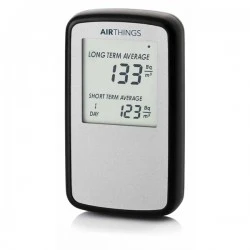
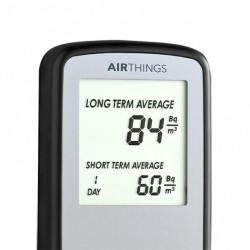
For this reason, experts strongly recommend long-term radon measurements (at least 2–3 months), preferably during the heating season. Only then can reliable conclusions be drawn.
Long-term vs. short-term radon measurements
Short-term measurements
- Duration: several days or weeks
- Useful for quick screening
- Highly dependent on current conditions
Long-term measurements (recommended)
- Duration: several months
- Account for seasonal variations
- Provide realistic average exposure values
>>> For decision-making and mitigation planning, long-term measurements are essential.
How to correctly interpret radon fluctuations?
- Fluctuations are normal and expected
- Short-term spikes do not necessarily indicate a permanent problem
- The key indicator is the long-term average value
If the long-term average exceeds recommended limits, mitigation measures should be implemented even if occasional low values occur.
What can be done if radon levels frequently increase?
1. Controlled ventilation
Regular ventilation is a basic measure, but automated solutions are far more reliable because they are not dependent on user behavior. One example is a system for automatic room ventilation with window opening , which ensures continuous and controlled air exchange.
2. Building improvements
- Sealing cracks and gaps in floors
- Sealing service penetrations and shafts
- Improving floor slab airtightness
3. Technical solutions
- Active ventilation of rooms or basements (for example, automated ventilation systems )
- Radon extraction systems, such as a duct fan for radon reduction
In practice, the most effective approach is often a combination of several measures, adapted to the specific building.
Conclusion: radon fluctuations are normal – understanding is essential
Changing radon levels are not a defect or error, but a natural characteristic of this gas. Concentrations depend on weather, season, ventilation, and lifestyle. Understanding these fluctuations is key to correctly interpreting measurement results.
>>> Do not focus on a single measurement – long-term average exposure matters most.
>>> With long-term measurements and appropriate technical solutions,
you can effectively protect your health and your home.
Short-term radon measurements can vary greatly due to weather and ventilation habits. For a realistic risk assessment, long-term measurements and carefully selected mitigation measures are strongly recommended.